Advertisement





Court finds manslaughter proven but accepts self-defence. Questions remain about the use of an unmarked police vehicle and the officers’ close approach
Three police officers from St. Maarten, Saba and Curaçao will face no criminal punishment for the fatal shooting of Rudolph “Rudy” Benjamin on February 13, 2026, after the Court of First Instance of St. Maarten ruled on November 27, 2026, that they had acted in self-defence.
The court found the charge of jointly committing manslaughter proven against all three officers. However, it concluded that their use of firearms was justified under the circumstances. The court therefore declared the proven offences not punishable and discharged the officers from further criminal prosecution.
The shooting took place on St. Peters Road, near Good News Baptist Church. The judgments provide a detailed reconstruction of the incident based on security-camera footage, witness statements, the officers’ accounts and forensic evidence.
At approximately 9:16 p.m., the police control room received a report of a man walking along Grapefruit Road in St. Peters with what appeared to be a firearm. According to the court’s account, a witness reported that Benjamin had pointed the object at him and made a threatening statement. The court also considered footage showing Benjamin pointing the object towards a supermarket across the street.
Three members of the police Flex Team responded. All three were wearing police uniforms but travelling in an unmarked silver-grey service vehicle.
An important question concerns why the officers were using an unmarked vehicle for this operation. The judgments do not provide a specific explanation for that choice or establish whether using this unmarked car was standard practice for the Flex Team.
The decision to approach at close range
The officers encountered Benjamin near the intersection of St. Peters Road and Tangerine Road. He was holding a dark object resembling a firearm in his right hand. After driving past him, they turned around and returned in his direction.
According to the judgments, the officers discussed an approach in which the vehicle would be brought as close as possible to Benjamin. The intention was for the officers to open the doors, identify themselves as police officers, physically overpower him and take the object away. Their stated objective was to disarm and arrest him.
The team had no immediate backup available, and the officer driving the vehicle indicated that there was little cover in the area.
The moments before the shooting
Security-camera footage shows Benjamin placing the object inside the front of his trousers at approximately 9:24:13 p.m. and pulling his shirt down over it. He subsequently stopped opposite Good News Baptist Church.
At approximately 9:24:53 p.m., the officers’ silver-grey vehicle stopped directly beside Benjamin, at very close range. The vehicle’s doors swung open. According to the court’s reconstruction, approximately one second later, Benjamin reached into the front of his trousers, removed the object and raised his arm towards the officer seated in the front passenger seat.
That officer stated that he identified himself as a police officer, saw Benjamin bring the object towards him, leaned backwards and fired his service weapon. The other two officers also opened fire almost immediately. They said they heard a gunshot and believed their colleague had been hit.
Camera footage shows the sequence of events
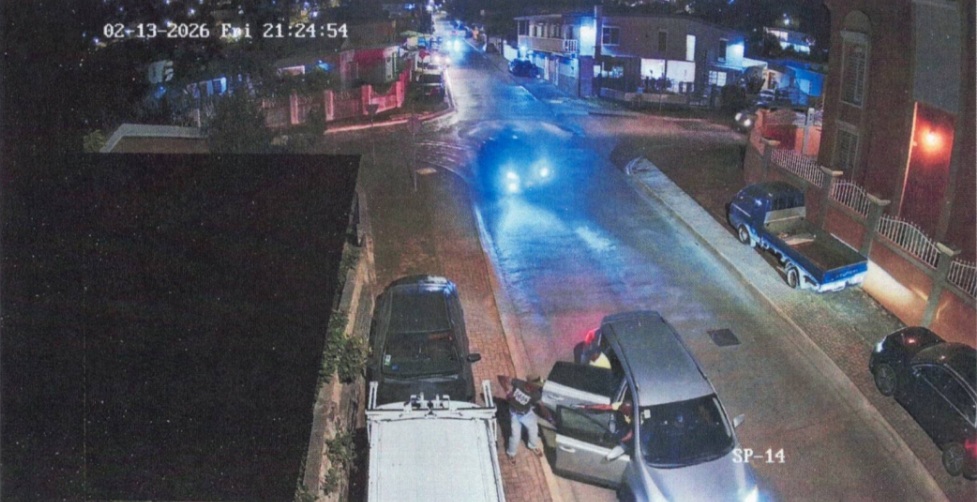
The CCTV photographs provide an additional visual record of the encounter. The first image, timestamped 9:24:54 p.m., shows the silver-grey vehicle stopped beside the sidewalk with its doors open.
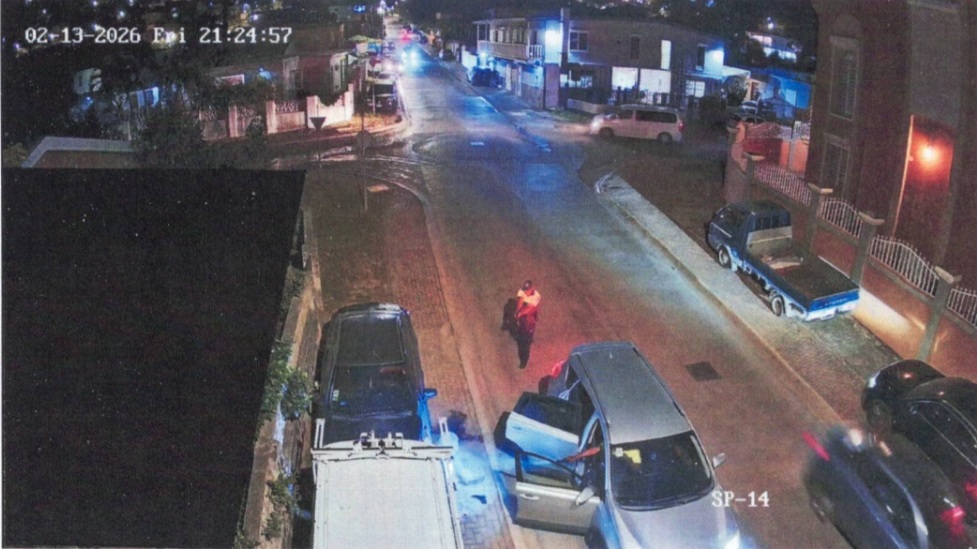
The second image, captured at 9:24:57 p.m., shows the vehicle with one officer standing behind it, his gun pointed at Benjamin, who is lying on the sidewalk.
The third image, timestamped 9:25:03 p.m., shows that the vehicle has moved forward, with the officers, dressed in dark blue and yellow, visible near the body.
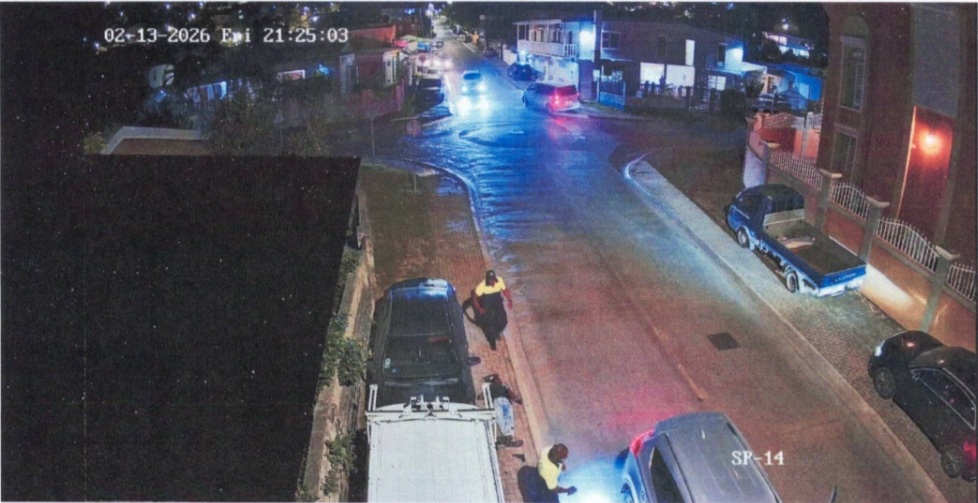
According to the court’s reconstruction, Benjamin fell backwards against a parked vehicle before falling to the ground.
The three photographs are separated by only nine seconds. They provide a visual reference for the vehicle’s position and the movements at the scene immediately after the shooting. The complete CCTV recording provides the broader sequence considered by the court.
What kind of weapon was Benjamin carrying?
An important question concerns the nature and capabilities of the object Benjamin was carrying.
The written judgments describe it as an air pistol. An English-language court press release reportedly referred to it as a blank-firing pistol, while local media reports have described it as a BB air pistol. Reporting on the forensic material has also identified the model as a CZ P-09 air pistol.
These descriptions are not necessarily interchangeable. The CZ P-09 air pistol is a CO₂-powered device designed to fire 4.5 mm pellets, with certain versions also accepting steel BB ammunition. It is not a conventional powder-fired firearm and is not designed to fire ordinary live firearm cartridges.
However, the fact that it is an air pistol does not automatically mean that it is harmless or incapable of causing a fatal injury. Medical literature contains documented cases of fatal injuries caused by airguns, including CO₂-powered BB pistols.
The published judgments do not establish whether Benjamin’s particular pistol was loaded, what ammunition it contained at the time or what its actual firing capability was under the circumstances. Nor do they provide a technical assessment establishing whether that specific pistol could have caused a fatal injury.
The officers said they believed Benjamin was carrying a real firearm and that they perceived an immediate threat when he took the object from his trousers. The court accepted that the object’s appearance and Benjamin’s movement gave them reasonable grounds to believe they were facing a real firearm.
The distinction between what the officers believed they were facing and what the object actually was remains important to understanding the incident.
Nine bullets causing 21 wounds
Forensic evidence established that at least ten shots were fired. The autopsy and CT scan established that nine bullets struck Benjamin, causing 21 wounds, including entry, exit and graze wounds.
The fatal injuries affected his heart, lungs and liver. The pathologist concluded that Benjamin died from blood loss caused by the gunshot injuries.
The court could not establish which officer fired the shot that caused the fatal injury. However, it found that the three officers had acted together. They had coordinated their approach, drawn their service weapons as part of the same operation and fired repeatedly at close range in rapid succession. The court concluded that their joint responsibility for manslaughter had been proven.
Joint responsibility for manslaughter
The court also found that firing repeatedly at a person from such a short distance demonstrated that the officers knowingly accepted a substantial risk of causing death.
It then examined whether their actions were legally justified by the circumstances in which the shooting occurred.
In assessing the defence of self-defence, the court considered both the officers’ decision to approach Benjamin closely and their subsequent decision to fire.
It took into account the original report of a man pointing what appeared to be a firearm in a public area, the absence of immediately available backup and the officers’ intention to disarm him.
The court concluded that the officers’ decision to approach Benjamin at close range did not prevent them from invoking self-defence. It found that their approach was not so careless that they had forfeited the right to defend themselves when the situation developed into an immediate threat.
When Benjamin produced the object and raised it towards the officer in the front passenger seat, the court found that the officers faced immediate danger at very close range. It concluded that they had no reasonable, less forceful alternative available to protect themselves and one another in the seconds in which the situation unfolded.
No time for a warning
The court also considered whether the officers should have issued a warning or fired a warning shot. It concluded that there was insufficient time to do so once Benjamin had produced and raised the object.
The closely spaced shots were assessed as part of a single response to the perceived threat. The court found that the officers’ use of firearms was necessary and proportionate and complied with the official instructions governing police use of service weapons.
At the November 13 hearing, the prosecutor acknowledged that the officers could have maintained a greater distance and attempted to speak to Benjamin before approaching him.
He nevertheless argued that the threat they perceived at the moment Benjamin produced the object justified their response. The court ultimately agreed with the prosecution’s position.
Psychological impact on the officers
The judgments also address the psychological consequences of the shooting for the officers. They described emotional distress, sleeping difficulties and problems returning to their police duties.
The officers sought professional assistance and explained that the incident had affected their private lives. The court acknowledged the impact the shooting had on them.
Benjamin’s family denied compensation
Benjamin’s family, meanwhile, has been left to deal with his death. His sister sought approximately Cg 50,000 in compensation for material and non-material damages, including funeral expenses and compensation for her loss.
The court acknowledged her grief but declared the compensation claim inadmissible in the criminal proceedings. Because the officers were discharged from criminal liability and no punishment or measure was imposed, the claim was not considered.
Related news
Register now online at SwiftPac.com to receive your packages in St. Maarten
Allen Chastanet to Receive 2026 CMEx Lifetime Achievement Award for Contributions to Caribbean Tourism
Dominica’s UWP Leader Calls for Electoral Commission to Address Alleged Voter List Discrepancies Ahead of December 16 Election
The passport business is closing
CMPH Mobilises Community Support for Stronger Protection of Children from Explicit Music
Opposition Raises Concerns Over Electoral Delays, Says 1,006 Voter Applications Remain Outstanding
Anguilla Records Seventh Consecutive Monthly Tourism Record as July Arrivals Surge
Carnival Corporation Engages Caribbean Tourism Stakeholders on Sustainability and Community Development
NCCU Introduces New Business Development Unit to Strengthen Support for Entrepreneurs
Dominica to Host Six-Match West Indies-Pakistan Women’s Cricket Series in December
Barbados Prepared to Establish National AI Regulations if CARICOM Framework Stalls, Says Mottley
###
ADVERTISEMENT