Advertisement





by The Wayfinder
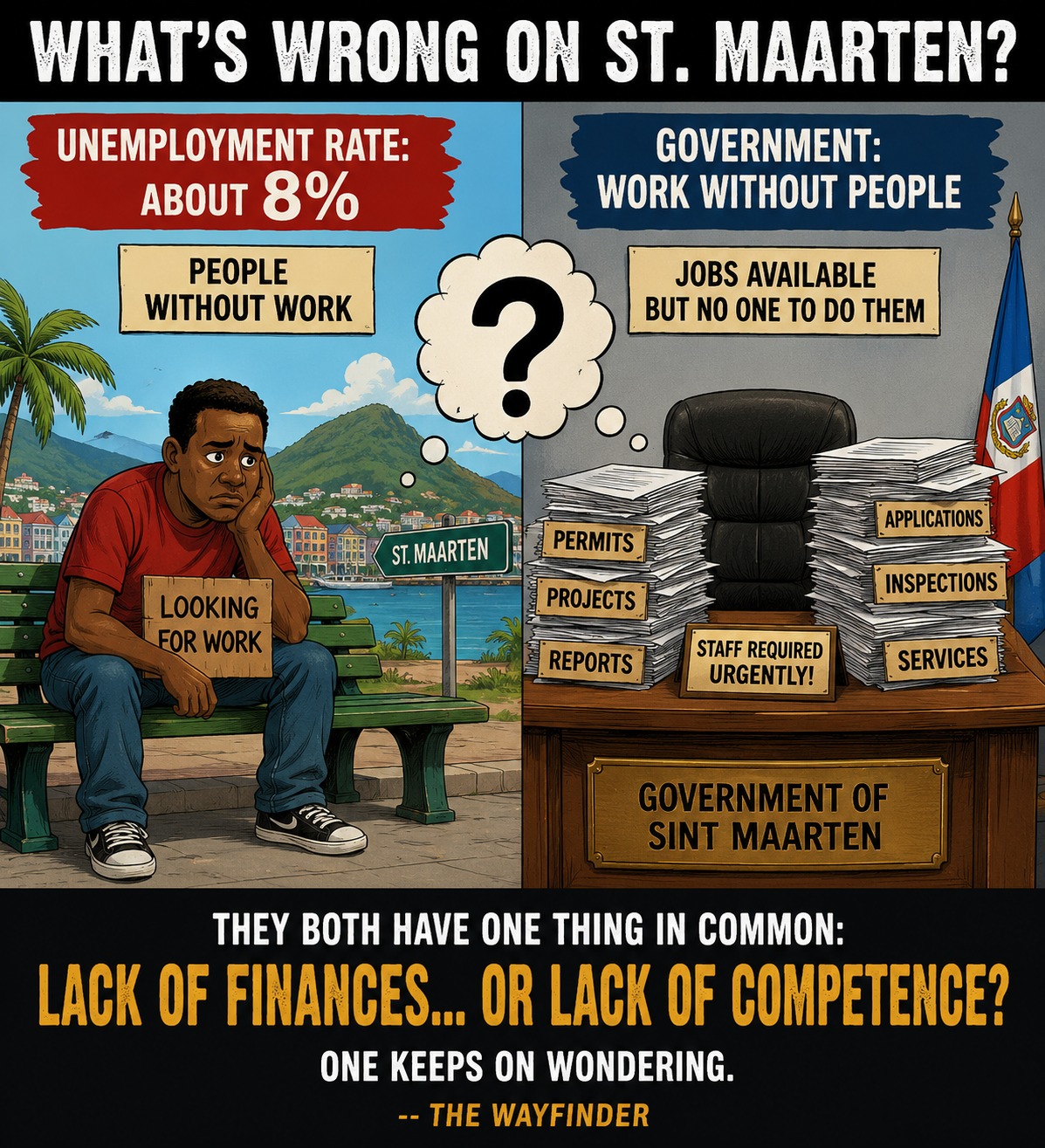
There is a peculiar situation in St. Maarten. There are people looking for work, and there is work looking for people. At first glance, this seems like good news. They should be getting along beautifully. But, apparently, they haven’t met yet. Now, such is annoying for the people without jobs and for the jobs without people. But especially for the people who have to figure out what to do about it.
It may be because of a system that lacks the ability to connect the two or a missing person who knows how to connect them. The first vacancy St. Maarten should fill is the one responsible for figuring out why the two have been living on the same island without ever meeting; a Matchmaker.
Forget a St. Maarten P&O department or human resource department. A new department that is much simpler is needed: a Department of Matchmaking with the fundamental objective to make matches, not to employ people.
Before launching another grand government solution—with a logo, a committee, and meetings about the meetings, one might try the scandalous first step: facts. Which jobs are vacant? What skills are actually needed? Who has them? Who can be trained? And why does filling one vacancy seem to require a geological era?
If qualified people are available but not hired, that is not a labor shortage; it is a bureaucratic magic trick. If people lack skills and no one trains them, that is policy asleep at its desk. And if the vacancies exist because government has more chairs than useful work, then it is a furniture problem with salaries attached.
The questions are simple: Are people qualified? If not, can they be trained? If yes, what is blocking the hiring—low wages, absurd requirements, jobs nobody wants, glacial recruitment, confused vacancies, or positions the public cannot justify with a straight face?
So, we may have found a solution. We’re setting up a Matchmaking Department. It’s going to link people to jobs. A wonderful idea. Matchmaking is a word that also sounds much friendlier. One is no longer unemployed. One is …. ‘not yet matched’. Yet…, not being matched could also mean a matchless match.
An enthusiastic matchmaker as we generally know them, continually tries to pair off the difficult bachelor with unattached ladies. “Matchmaker, matchmaker, make me a match, find me a find, catch me a catch”. A real matchmaker would not simply introduce two people and hope for romance. It would know what each one wants, what each one can offer, and whether the two are actually compatible.
Employment shouldn’t be very different. The Department of Matchmaking doesn’t look at what job openings there are. They look at whether the right person ends up in the right job. It’s just… still a single person.
The currently still existing problem is that not a good enough job has been done of connecting people to opportunity. Who is responsible for connecting the two? That shifts the discussion from blame to accountability. The goal should be more people working, more skills being developed, and more value being created. That’s how a contradiction is turned into an opportunity.
Unfilled essential jobs are a management problem. Unemployment is a social problem. When both exist at the same time, the connection needs to be explained. Eight percent unemployment is not just a statistic.
It represents people who want to work, people who want to provide for their families, and people who want the opportunity to contribute. At the same time, government has vacancies that remain unfilled. So the question isn’t simply, ‘Why don’t people have jobs?’ And it isn’t simply, ‘Why can’t government find people?’ The question is: Why aren’t we connecting the people who need work with the work that needs to be done? That is a problem that needs to be solved.
Who should work in the Matchmaking Department? People who understand people! People who understand jobs! People who can see if two people fit together. And especially people who can say: “Sorry, but this isn’t a match” even to a friend in the community. That seems like a very important trait for the government. Being able to say NO, and what part of NO don’t you understand. Because if everyone is suitable for every job, one doesn’t even need a matchmaker but rather only a rubber stamp.
Appoint someone who has a demonstrable record of putting people into productive jobs. People who know how to match people with jobs. Recruit somebody with actual employment-placement experience. Don’t appoint the person with the longest government résumé. Not already employed administrative assistants who merely process applications. The department needs people who understand people, jobs and evidence. One doesn’t want some person who never hired anybody telling one how to hire people. One doesn’t put a person who can’t swim in charge of the swimming pool.
If the Matchmaker department can’t fill its own vacancies… then we may have finally found a department that explains the problem itself in one go and one at least knows where the problem lies: with the department itself.
If the Matchmaking Department succeeds, it can eventually close be closed. After all, a really good matchmaker works himself out of a job. The Matchmakers should really have one mission: make themselves unnecessary. Nothing more left to match. Problem solved.
A department whose ultimate success is making itself smaller would be a rather refreshing concept in government. That might be the only government department that one can say about that the better it performs, the smaller it can get. It proves that it doesn’t make the Matchmaker some new bureaucratic institution, but a temporary problem-solving mechanism. If the Matchmaker Department does its job right… eventually there won’t be much for them to do. That’s what is called efficiency.
A somewhat unconventional solution for consideration is offered here. The remaining problem is awaiting a decision. Sint Maarten cannot afford to waste the two resources involved here: people who need work, and work that needs people.
About The Wayfinder
A Wayfinder defines a role rather than a person. A Wayfinder is not a leader, a politician, or a critic. A Wayfinder asks questions, studies patterns, and searches for the safest and wisest course ahead. These essays are offered in that spirit—not as answers, but as invitations to think together.
###
Related articles:
Truth before popularity. Accuracy before fashion
St. Maarten doesn’t need cheerleaders
Destinations Are Now Parking Lots for Cruise Ships
Caribbean Unity or Cruise Dependency? The Time to Decide Is Now
###
ADVERTISEMENT