Advertisement





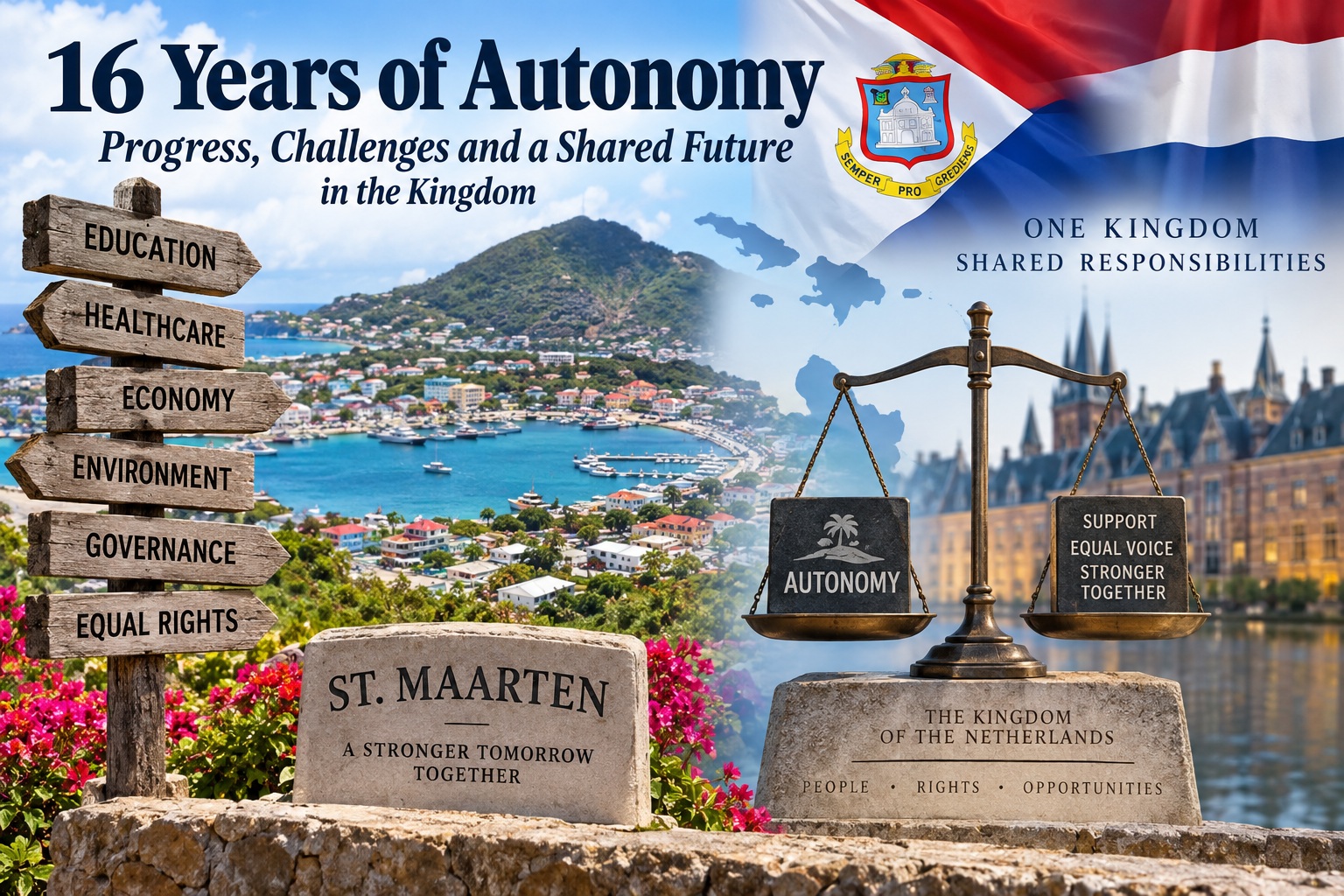
PHILIPSBURG — Sixteen years ago St. Maarten became an autonomous country within the Kingdom of the Netherlands. Wouter Veenenedaal, extraordinary professor Kingdom Relations at Leiden University and Oberon Nauta, a senior researcher at the DSP-Group shed their light on the results in an opinion piece published in The Volkskrant this week. Their observations suggest that St. Maarten (as well Curacao) is unable to execute all the tasks it has on its plate.
“Autonomy is asking too much off the small Caribbean countries,” Veenendaal and Nauta write. “Because vital government tasks get stuck and situations threaten to become unacceptable, the kingdom had to come to the rescue again and again. But the support from the kingdom often happens under exclusive Dutch conditions.”
The authors note that this has resulted in an untenable situation. On paper the countries are autonomous but in practice that same autonomy is more and more being neglected.
“Because the Caribbean countries do not have much of a say in the Kingdom, interventions occur regularly ad hoc and selectively, based on the prevalent logic in The Hague.”
Veenendaal and Nauta suggest a solution. It would be better if the Kingdom takes care of tasks that the countries cannot execute independently. “But in that scenario the Caribbean countries and their citizens must get a stronger voice in the Kingdom. Right now, the Netherlands takes all decisions unilaterally.”
The authors are not surprised that the Kingdom had made a habit of neglecting the autonomous status of St. Maarten and Curacao. They refer to serious environmental problems, migration and social-economic issues.
“There are some improvements but the problems remain.”Education falls further and further behind European standards, healthcare is struggling with financial and organizational shortfalls and the execution of government tasks remains vulnerable due to a lack of capacity. Public finances also remain a source of concern.”
Why is this so? The authors point out that the scale of the islands is comparable with mid-sized Dutch municipalities but that they have to execute all the duties of an autonomous country, All this results in a fundamental problem: Dutch citizens in the Caribbean find themselves increasingly in a second-class position.
“Within one Kingdom we therefore see unacceptable differences in the quality of life. The most important explanation for it is the autonomy of the Caribbean countries. Their governments and the Netherlands hide behind it. Autonomy enables the countries to keep the Netherlands at bay, even when it is clear that they are unable to manage their own challenges. The Netherlands uses that same autonomy as a justification for doing nothing, for instance in the case of serious environmental challenges or the violation of human rights.
The mantra in The Hague remains that the autonomous countries have to settle these matters.
It is not that the Netherlands does nothing at all. It gives special attention to issues like good governance and public finances. Veenendaal and Nauta refer to financial supervision and, in St. Maarten’s case, the forced establishment of an Integrity Chamber. The Netherlands also pushed for economic reform.
“But in other fields, like education, healthcare, social security and climate adaptation the Netherlands is re-active, or it looks the other way.”
The Kingdom Charter established that the Kingdom is obliged to guarantee fundamental human rights in all of the kingdom. According to the authors, this includes the right to education, the right to a clean living environment and the right to a decent standard of living.
“If we really want to realize the human rights for all Dutch citizens, a larger administrative role for the Kingdom is inevitable. “To prevent that the Netherlands determines everything, a crucial second step is necessary. The Caribbean countries must get a stronger influence in the Kingdom, while the Netherlands has to take a step back.”
There is another thing: If the Caribbean countries give up some of their autonomy it becomes crucial from a democratic point of view that they get a bigger say in the Kingdom. “Concretely this means that the lack of parliamentary representation (the democratic deficit) has to be solved and that the Caribbean participation in the Kingdom government must be strengthened. This way the islands will get more ownership of the Kingdom while the Netherlands has to face the fact that the Kingdom is more than just its European part.”
Veenendaal and Nauta point out that there are quite some small island territories that have a much stronger position in the larger state to which they belong. They mention for example the Faroër and Greenland (both a part of Denmark) and the Azores and Madeira (both a part of Portugal) that do have representatives in their national parliaments.
“Based on these examples a search is justified for a Kingdom that can offer equal circumstances to its citizens.”
###
ADVERTISEMENT