Advertisement





~ When critical national infrastructure disappears behind a corporate curtain, the public has every right to ask questions ~
By Terrance Rey
The debate surrounding N.V. GEBE’s fuel clause has exposed something much larger than the monthly electricity bills confronting households and businesses across St. Maarten. It has exposed a transparency problem. Not merely about electricity. Not merely about water. But about who ultimately controls one of the country’s most critical pieces of national infrastructure.
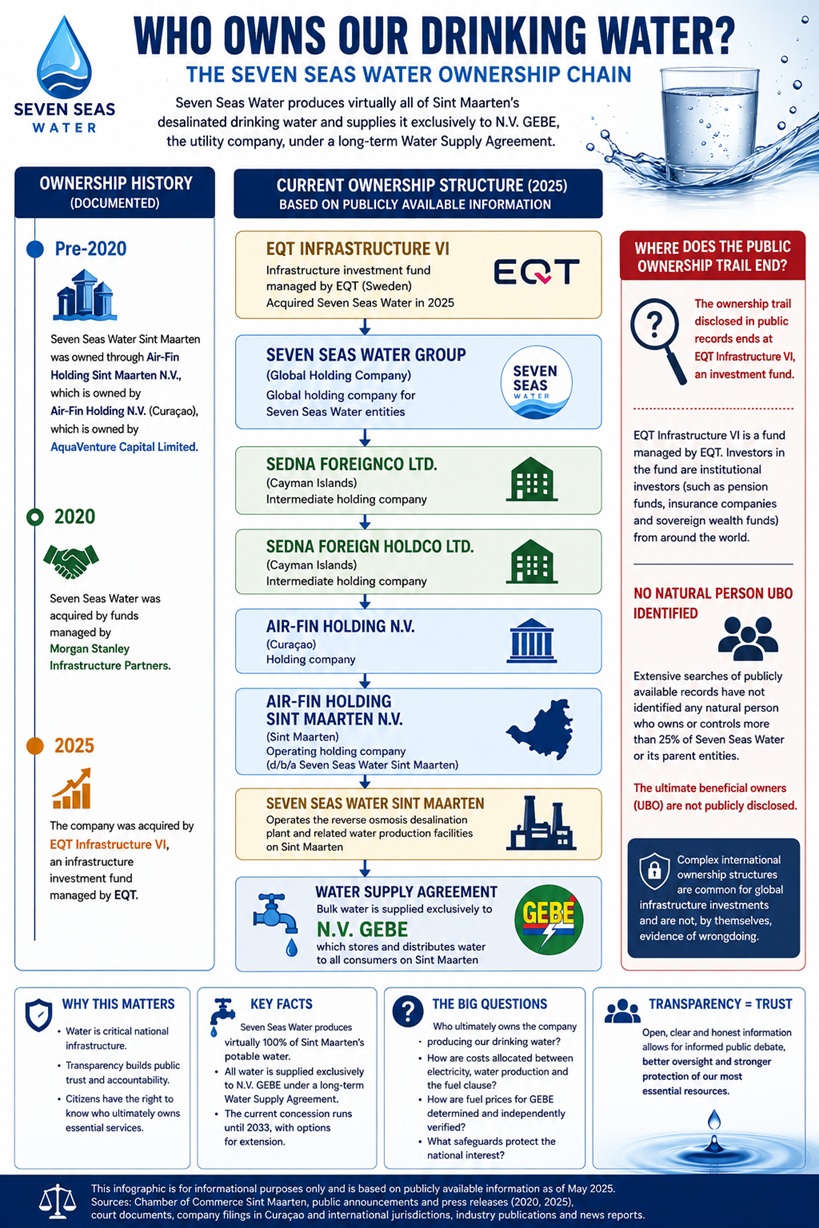
Every cup of water that flows from our taps begins at Seven Seas Water, operating through Air-Fin Holding Sint Maarten N.V., the company responsible for producing virtually all of St. Maarten’s potable water under a long-term Water Supply Agreement with the Government of St. Maarten. GEBE purchases that water in bulk and distributes it to homes and businesses throughout the country.
That alone makes Seven Seas one of the most strategically important companies operating in St. Maarten.
Yet a remarkably simple question appears surprisingly difficult to answer:
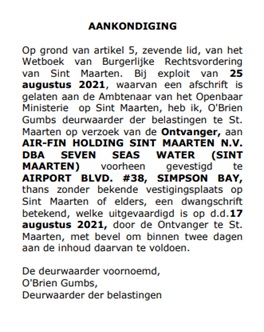
Who ultimately owns Seven Seas?
A Question Every Citizen Should Be Able to Answer
In a democracy, ownership of critical infrastructure should never be a mystery. Imagine asking who owns Princess Juliana International Airport. Imagine asking who owns the Harbour. Imagine asking who owns our telecommunications network.
These are not merely commercial enterprises. They are assets upon which the country’s economy, security and daily life depend. Water belongs in exactly the same category.
Without electricity we experience inconvenience. Without water, we face a national emergency.
That is why ownership transparency matters.
Following the Corporate Trail
Public records show that the company historically operated through Air-Fin Holding Sint Maarten N.V., itself owned by Air-Fin Holding N.V. in Curaçao. Historically, those companies formed part of AquaVenture Holdings.
In 2020, Seven Seas Water was acquired by funds managed by Morgan Stanley Infrastructure Partners.
In 2025, ownership changed again when the company became part of EQT Infrastructure VI, an infrastructure investment fund managed by the global investment firm EQT.
So far, so good.
But here the trail becomes considerably more difficult to follow. The ownership chain continues through several intermediate holding companies incorporated in multiple jurisdictions. Extensive public research reveals the corporate structure.
It does not clearly reveal any natural person who ultimately owns or controls more than twenty-five percent of the enterprise.
That does not imply anything improper.
Large international infrastructure funds frequently use complex holding structures. But it does create an uncomfortable reality.
The company producing nearly all of St. Maarten’s drinking water has an ownership structure that is largely invisible to the average citizen.
Should that concern us?
Perhaps.
At the very least, it deserves discussion.
The Fuel Clause Debate Raises Even More Questions
This issue becomes even more significant because Seven Seas has now entered the public discussion surrounding GEBE’s controversial fuel clause.
A recent Facebook post by Sheldon Ellis argues that residents may effectively be paying part of the cost of water production through the electricity fuel clause, because Seven Seas uses electricity supplied by GEBE to operate its desalination plants.
That is an argument worthy of careful examination.
If correct, it raises important policy questions.
If incorrect, the Government, GEBE and the regulator should clearly explain why.
Either way, transparency benefits everyone.
Citizens deserve to understand precisely what costs are included in the fuel clause and how those costs are allocated.
How much relates strictly to electricity generation?
How much relates to water production?
What assumptions underpin those calculations?
The recently published tariff evaluation commissioned by Government provides valuable insight into the operation of both the electricity and potable water sectors, but it should be the beginning of a broader public conversation rather than the end of one.
The Other Mystery: Fuel Pricing
The questions do not stop there.
Another component affecting the fuel clause concerns the price of heavy fuel oil, light fuel oil and lubricants supplied to GEBE.
Retail fuel prices in St. Maarten are subject to government oversight.
Inspectors from the Ministry of TEATT monitor those prices, and Government periodically publishes maximum prices for gasoline and diesel sold at service stations.
Yet the commercial pricing arrangements governing fuel supplied to GEBE are far less visible to the public.
What pricing mechanism applies?
How are those prices benchmarked?
Who verifies that the prices paid are competitive?
Again, these are not accusations.
They are questions.
Important questions.
Throughput Fees and Public Costs
The same applies to throughput fees charged within the fuel supply chain.
Public discussion has suggested that portions of these fees ultimately support financing arrangements connected with harbour infrastructure.
If true, the public deserves to understand precisely how those mechanisms operate.
If false, they deserve clarification.
Solar powered light remains the best antidote to misinformation.
Transparency Builds Trust
None of this should be interpreted as criticism of Seven Seas Water NV.
Nor is it an accusation against NV GEBE.
Nor against SOL Gas NV.
Nor against the Government of St. Maarten.
Companies providing essential services deserve stable commercial environments.
But they also benefit from public confidence.
Confidence is built through openness.
Not opacity.
When citizens can easily understand ownership structures, pricing mechanisms, contractual obligations and regulatory oversight, speculation naturally diminishes.
When those answers are difficult to obtain, rumours inevitably fill the vacuum.
A National Security Issue
This discussion ultimately extends beyond accounting.
Drinking water is a national security issue.
Every developed country carefully scrutinises ownership and control of strategic infrastructure.
Airports.
Ports.
Power grids.
Telecommunications.
Water.
St. Maarten should be no different.
Whether ownership resides with local investors, international infrastructure funds or multinational corporations is not, in itself, the issue.
The issue is whether the public can clearly understand who controls these essential assets and whether sufficient oversight exists to protect the national interest.
Questions Parliament Should Consider
Perhaps it is time for Parliament to ask several straightforward questions:
- Who ultimately owns the company producing St. Maarten’s drinking water?
- What change-of-control provisions exist within the Water Supply Agreement?
- How does Government monitor ownership changes?
- Which components of the fuel clause relate directly or indirectly to water production?
- How are fuel prices supplied to GEBE determined and independently verified?
- What safeguards exist to protect consumers while ensuring long-term investment in essential infrastructure?
These are not partisan questions.
They are governance questions.
They are accountability questions.
Most importantly, they are questions every citizen should be able to ask without controversy.
Because drinking water is not merely another commodity.
It is one of the foundations of national security.
And the ownership of critical national infrastructure should never remain hidden behind a corporate curtain.
###
Related links:
Sheldon Ellis post on Facebook>>>
Evaluation of Electricity and Potable Water Tariffs Sint Maarten
###
ADVERTISEMENT