Advertisement





By Terrance Rey
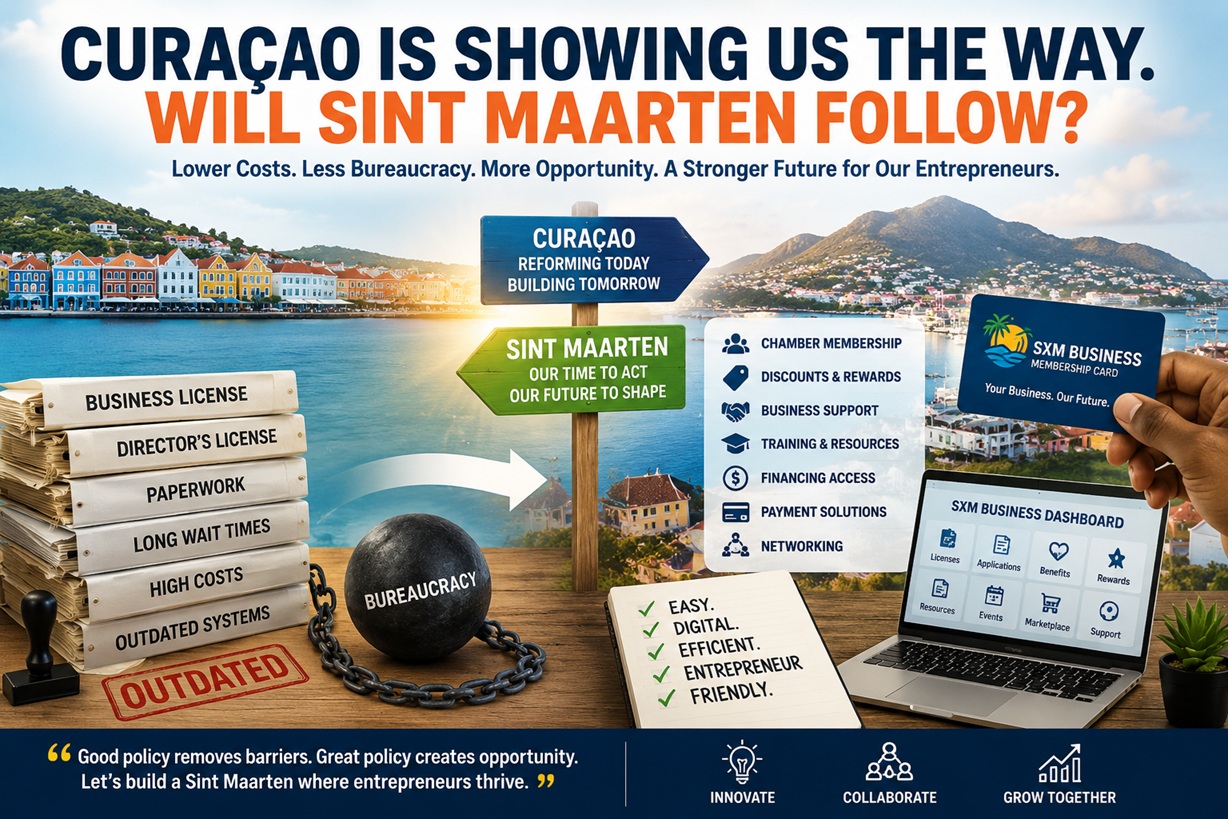
This week I read with great interest that Curaçao is preparing a new round of economic reforms aimed at reducing bureaucracy, lowering the cost of doing business, improving digital government services, and creating a more attractive investment climate. The reforms are part of a broader effort to remove administrative barriers that have frustrated entrepreneurs and investors for years. (Curacao Chronicle)
My first reaction was simple:
Good.
My second reaction was:
When will Sint Maarten do the same?
For years, politicians, civil servants, business associations, and entrepreneurs have spoken about economic diversification, attracting investment, creating jobs, supporting small businesses, and stimulating innovation. Yet many of the barriers that stand in the way of those objectives remain firmly in place.
The reality is that Sint Maarten is still operating much of its business environment according to a model designed for a different era.
An era before digital businesses.
Before remote work.
Before e-commerce.
Before online service providers.
Before content creators.
Before software developers.
Before digital nomads.
Before entrepreneurs could serve customers in ten countries while sitting behind a laptop in Philipsburg, Cole Bay, Belair, or Dutch Quarter.
One of the clearest examples is our Business License and Director’s License system.
I understand the historical reasons why these requirements were introduced. Governments wanted to know who was doing business, who was operating a company, and whether foreign nationals met certain criteria before engaging in economic activity.
But we should also be honest enough to ask a difficult question:
Is the current system still serving the purpose for which it was originally created?
In practice, the overwhelming majority of businesses on Sint Maarten are never asked to produce a Business License or Director’s License after receiving one.
Restaurants are inspected.
Bars are inspected.
Supermarkets are inspected.
Retail establishments may be inspected.
But the growing segment of entrepreneurs operating from home offices, laptops, mobile phones, websites, apps, and digital platforms often receive little practical benefit in exchange for the bureaucracy they must navigate.
If a business owner can establish an online company in Estonia, Delaware, Wyoming, The Netherlands, or Dubai in a matter of hours, why should it take months to obtain approvals on Sint Maarten?
The world is moving in one direction.
We continue to move in another.
What if, instead of viewing licensing solely as a regulatory burden, we transformed it into a business support system?
What if obtaining a business license actually became valuable?
Imagine a new category specifically designed for entrepreneurs, freelancers, sole proprietors, digital service providers, consultants, content creators, and e-commerce operators.
Instead of merely receiving a piece of paper, the entrepreneur would receive a Business Membership Card.
That card could automatically include:
- Chamber of Commerce membership
- Access to training programs
- Discount programs at participating businesses
- Office supply discounts
- Fuel discounts
- Telecommunications discounts
- Banking and payment processing solutions
- Access to government grants
- Access to financing opportunities
- Networking events
- Business insurance options
- Reward points for business spending
Instead of being viewed as another government obligation, the license would become a gateway to benefits.
The entrepreneur would see value.
Government would see compliance.
The economy would see growth.
Everybody wins.
In many ways, I have already envisioned something similar through the Sunmiles Club concept and the business dashboard systems I have been developing.
The principle is simple:
Create an ecosystem where entrepreneurs benefit from participating.
People respond far better to incentives than they do to bureaucracy.
If government wants more businesses to register formally, then formalization should come with tangible advantages.
The same philosophy should apply to government services in general.
Curaçao is moving toward digital signatures, digital government services, shorter permit procedures, and easier access to information. (Curacao Chronicle)
That should not be viewed as a luxury.
It should be viewed as an economic necessity.
Every hour an entrepreneur spends chasing paperwork is an hour not spent serving customers.
Every month spent waiting for approvals is a month of lost economic activity.
Every unnecessary procedure increases the cost of doing business.
And ultimately those costs are passed on to consumers.
The discussion should not be whether government should regulate.
Government has an important regulatory role.
The discussion should be whether regulation is helping economic development or hindering it.
There is a difference.
Modern economies compete for entrepreneurs.
They compete for talent.
They compete for investment.
They compete for innovation.
The jurisdictions that make it easiest to start and grow a business are usually the ones that attract the most investment.
That is not coincidence.
That is policy.
Curaçao appears to understand this reality. The reform agenda focuses not only on government procedures but also on digitalization, financing, sustainability, and stronger cooperation between public and private stakeholders. (Curacao Chronicle)
Sint Maarten should be paying close attention.
Because while our tourism industry remains strong, we cannot build a resilient economy solely on tourism.
We need technology.
We need e-commerce.
We need digital exports.
We need software companies.
We need online service providers.
We need entrepreneurs who can generate income from customers around the world without depending entirely on cruise arrivals or airline schedules.
The beauty of digital business is that it allows a small island to compete globally.
A software developer in Sint Maarten can serve a client in Canada.
A graphic designer can serve a customer in Germany.
A travel platform like CaribbeanJets.com can sell services throughout the Caribbean.
A media company can reach readers across the Kingdom.
Physical size no longer limits economic opportunity.
But outdated systems still can.
The future economy of Sint Maarten will not be built solely by hotels, restaurants, and retail stores.
It will also be built by entrepreneurs sitting behind computers, creating products, services, software, content, and digital platforms.
Government policy must evolve to recognize that reality.
Curaçao is taking steps in that direction.
The question is whether Sint Maarten will lead, follow, or continue debating while others move ahead.
Personally, I hope we choose to move ahead.
Because lowering the cost of doing business is not merely an economic reform.
It is an investment in the future prosperity of our country.
###
ADVERTISEMENT