Advertisement





By Terrance Rey
The St. Maarten Chamber of Commerce & Industry (COCI) deserves recognition for the overwhelming response to its Start Smart Pilot Project. The fact that 72 aspiring and existing entrepreneurs qualified for the program demonstrates something many of us have known for years: there is no shortage of entrepreneurial spirit on St. Maarten.
Training in financial management, marketing, artificial intelligence, customer engagement and business development is an excellent start. Knowledge is one of the greatest investments we can make in our people.
But if we are serious about creating an economic revival led by local entrepreneurs, then we must also ask a more fundamental question.
What happens after the training ends?
For many startups, the excitement of launching a business quickly collides with reality.
Before the first dollar is earned, entrepreneurs are already confronted with notary fees, Chamber of Commerce registration fees, business license fees, director’s license fees, economic licenses, accounting expenses and numerous other startup costs. Then comes the administrative burden of complying with the tax system.
Every month, entrepreneurs must calculate, file and pay Turnover Tax (TOT), often while trying to build a customer base, manage cash flow and simply keep the doors open.
Many small business owners spend more time worrying about paperwork than growing their business.
That is why I believe St. Maarten should introduce a bold new economic policy.
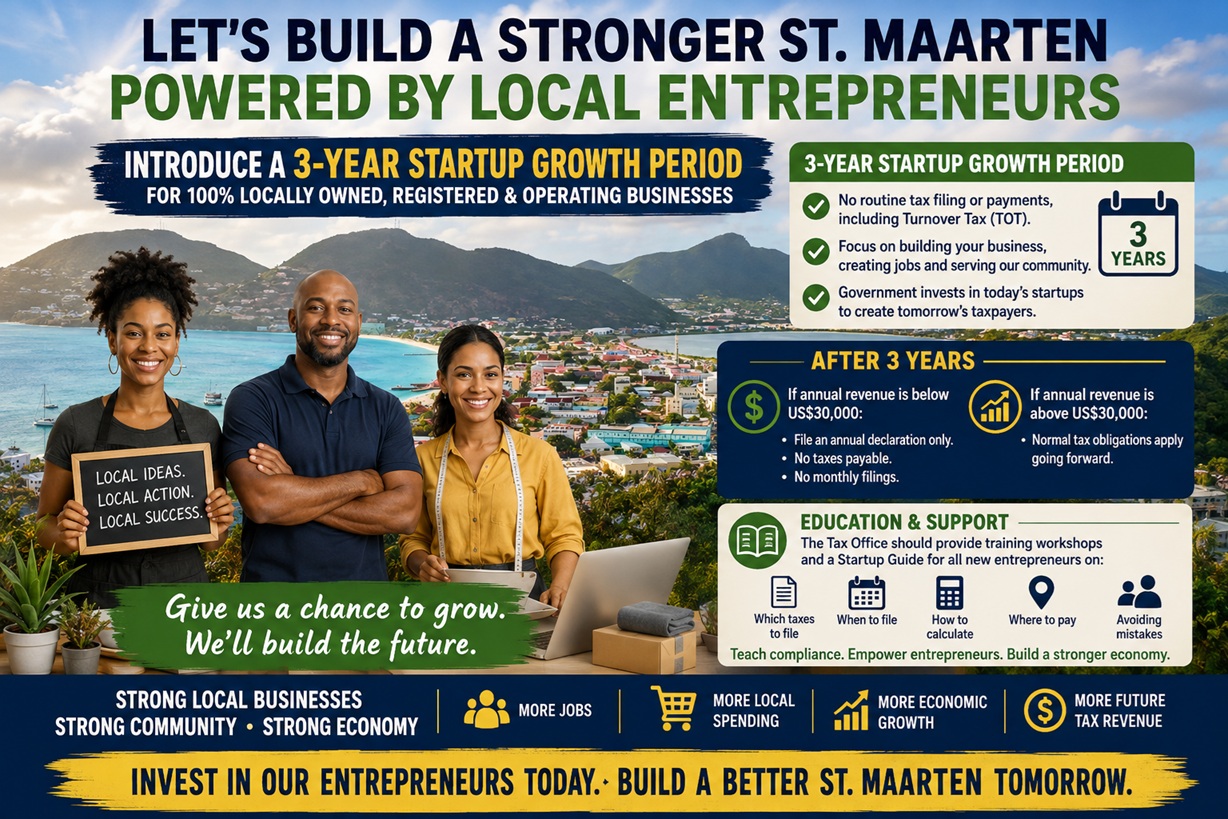
A Three-Year Startup Growth Period
Every new business that is 100 percent locally owned, registered and operating in St. Maarten should qualify for a three-year Startup Growth Period.
The Startup Growth Period would temporarily suspend routine tax filing and payment obligations, including Turnover Tax (TOT), allowing entrepreneurs to concentrate on building their businesses instead of navigating bureaucracy.
The objective is simple.
Give entrepreneurs three years to establish a customer base, generate revenue, create employment, improve their products and services, and build financially sustainable businesses before introducing the full administrative burden of taxation.
Government should view those first three years as an investment in creating tomorrow’s taxpayers rather than trying to maximize tax collection from businesses that are still struggling to survive.
After the Startup Growth Period
At the end of the three-year Startup Growth Period, businesses would enter the normal tax system.
However, there should be one important safeguard for very small businesses.
If, after those three years, a business generates annual revenue of less than US$30,000, it should simply file an annual declaration confirming that its revenue remains below the threshold.
No taxes should be payable.
No monthly filing requirements.
No unnecessary administrative burden.
Only when a business exceeds the US$30,000 annual revenue threshold should the normal tax obligations fully apply.
This recognizes an important economic reality.
A business generating less than US$30,000 annually is often little more than a self-employed individual trying to make a living. Burdening such entrepreneurs with extensive monthly filing requirements costs both the entrepreneur and the government more than the revenue ultimately collected.
Teach Entrepreneurs How to Comply
The success of COCI’s Start Smart initiative also highlights another opportunity.
The knowledge shared during the program should not end with the final training session.
Every newly registered business owner should receive a practical Startup Guide explaining, in clear language:
- Which taxes must be filed.
- When each tax must be filed.
- How each tax is calculated.
- Where payments must be made.
- Which government department receives each payment.
- Common mistakes that result in penalties and tax assessments.
- Practical examples using real business scenarios.
In addition, the Tax Administration should organize regular workshops throughout the year for new entrepreneurs.
Government should not simply enforce compliance.
It should actively teach compliance.
An entrepreneur who understands the system is far more likely to comply voluntarily than one who is overwhelmed by unfamiliar rules and procedures.
Investing in Local Entrepreneurs
Some may ask whether government can afford such a Startup Growth Period.
I would argue that the better question is whether we can afford not to.
Every successful local business creates jobs.
Every successful local business purchases goods and services locally.
Every successful local business keeps more money circulating within the St. Maarten economy.
Every successful local business eventually becomes a taxpayer.
The goal should not be to collect as much tax as possible from businesses during their most vulnerable years.
The goal should be to help create businesses that survive long enough to become taxpayers for decades.
That is a far better return on investment.
The comments generated by this proposal have already shown that there are many ideas worth discussing. Some have suggested extending the Startup Growth Period to five years. Others have proposed reducing or eliminating profit tax, or restructuring the tax system altogether. Still others have pointed to the need for a level playing field between local businesses and direct online imports.
Those are all worthwhile conversations.
But they should not distract from the central issue.
Government should stop treating startups like mature companies.
A multinational corporation, a twenty-year-old established business and a sole proprietor who registered yesterday should not all be subjected to exactly the same administrative burden.
If we truly want an economic revival powered by locals, we must stop thinking only about collecting taxes and start thinking about creating taxpayers.
Sometimes the best way to increase tomorrow’s tax revenue is to reduce today’s regulatory burden.
That is precisely what a Startup Growth Period is designed to achieve.
###
Related articles:
Proposal for 3-Year Startup Growth Strategy faces severe political and structural roadblocks on Sint Maarten
Investment Promotion Begins at Home
The Caribbean Must Stop Exporting Its Tourism Dollars
###
ADVERTISEMENT