Advertisement





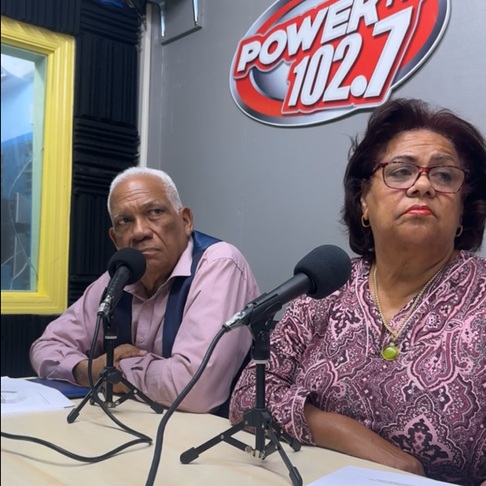
PHILIPSBURG — The Sint Maarten Anti Poverty Platform (SMAPP) is seeking to fundamentally change the way Government and Parliament approach the country’s annual budget, arguing that balancing the government’s finances is not enough if thousands of households remain unable to meet their basic needs.
In an open letter addressed to Government and Parliament, supported by a detailed policy presentation and accompanying briefing speech, SMAPP coordinators Drs. Raymond Jessurun and Claire Elshot Aventurin call for the 2026 Country Budget to be amended so that poverty reduction becomes a measurable national objective rather than simply a stated policy intention.
According to the platform, the real test of a national budget is not whether government revenues exceed expenditures, but whether ordinary families can afford housing, food, utilities, healthcare, transportation, education and other necessities required to live with dignity.
Shifting the Budget Debate
At the heart of SMAPP’s proposal is a simple question:
Can households in Sint Maarten meet their basic needs with the income available to them?
The organization argues that the 2026 Country Budget, while projecting approximately XCG 635.9 million in ordinary expenditure and XCG 647.1 million in ordinary income, does not answer several critical questions:
- What constitutes a minimum basic needs income?
- How many households fall below that threshold?
- What is the total income shortfall?
- How much of the existing social spending actually reduces that gap?
- What additional policies will reduce poverty during 2026?
Rather than focusing solely on government finances, SMAPP wants Parliament to examine the financial reality facing households across the country.
Three Scenarios
Recognizing that Sint Maarten currently lacks an officially adopted poverty line, SMAPP proposes a three scenario framework.
The Low Scenario updates the former Netherlands Antilles 1974 basic needs basket for inflation, resulting in a monthly benchmark of approximately XCG 4,102 for a one person household.
The Central Scenario, which SMAPP considers a more realistic provisional benchmark, adds approximately XCG 250 per month to reflect modern necessities such as internet connectivity, mobile communication and digital access, producing a monthly basic needs income of XCG 4,352.
A third Full Adequacy Scenario would eventually rely on household specific reference budgets currently being developed by Nibud, allowing different household types to be assessed according to their actual needs rather than using a single national benchmark.
Poverty Measured in Households
Using Census household income data, SMAPP estimates that under its Central Scenario approximately 9,725 households fall below the proposed basic needs level.
The organization estimates the aggregate annual income gap between household income and the minimum basic needs standard at approximately XCG 264.5 million.
After assuming that approximately XCG 36 million in existing social programs directly reduce this deficit, SMAPP calculates a remaining gap of approximately XCG 228.5 million.
Importantly, the platform stresses that it is not proposing that Government simply distribute XCG 264.5 million in cash, but rather that policymakers develop a comprehensive strategy to progressively close the income gap through multiple policy instruments.
A Broader Policy Mix
Instead of relying exclusively on government subsidies, SMAPP proposes what it describes as a mixed financing approach.
Under its illustrative model, approximately:
- 40% of the gap would be addressed through higher wages and employment income.
- 15% through tax relief and refundable tax credits.
- 15% through stronger social security and income replacement programs.
- 10% through lower costs for housing, utilities and other essential services.
- 20% through targeted direct government budget support.
Under this approach, the direct additional government appropriation would amount to roughly XCG 45.7 million, representing only one component of a broader poverty reduction strategy rather than the total estimated gap.
Human Rights Framework
A significant aspect of SMAPP’s campaign is its argument that poverty reduction is not merely an economic policy issue but also a human rights obligation.
The platform cites Article 2 of the International Covenant on Economic, Social and Cultural Rights, which requires governments to progressively realize rights such as adequate housing, food, healthcare, education and social security using the maximum available resources.
It also references Article 43 of the Charter for the Kingdom of the Netherlands, arguing that while Sint Maarten bears primary responsibility for protecting these rights, the Kingdom also has a safeguarding role where structural limitations prevent their realization.
A Public Awareness Campaign
The documents appear to form part of a broader public education and awareness initiative by SMAPP.
Rather than presenting poverty solely as a social welfare issue, the organization seeks to reframe it as a measurable public finance issue that should become an integral part of annual budget debates.
Among its recommendations are quarterly parliamentary reporting on poverty reduction, publication of the number of households below the basic needs threshold, measurement of the income gap over time, and the inclusion of a dedicated “Basic Needs Gap and Human Rights Annex” in future national budgets.
Invitation to Public Discussion
Jessurun has invited StMaartenNews.com to host an exclusive interview to explain the research in greater detail, indicating that he and Claire Elshot Aventurin intend to present the statistical foundation behind their analysis and stimulate a wider national discussion about poverty, household finances and the adequacy of the country’s budget.
The proposed discussion is expected to focus not only on the scale of poverty in Sint Maarten, but also on whether the country’s budget should be judged by its impact on the financial well being of ordinary households as much as by the government’s own fiscal balance.
Whether Government and Parliament embrace SMAPP’s proposals remains to be seen. However, the platform is clearly attempting to elevate the public conversation beyond traditional political debates by asking what it considers to be the most fundamental budget question:
Can the people of Sint Maarten actually afford to live with dignity?
###
Download “Open letter SMAPP for COM and Parliament SXM” here>>>
Editorial: The Poverty We Refuse to See
###
ADVERTISEMENT