Advertisement





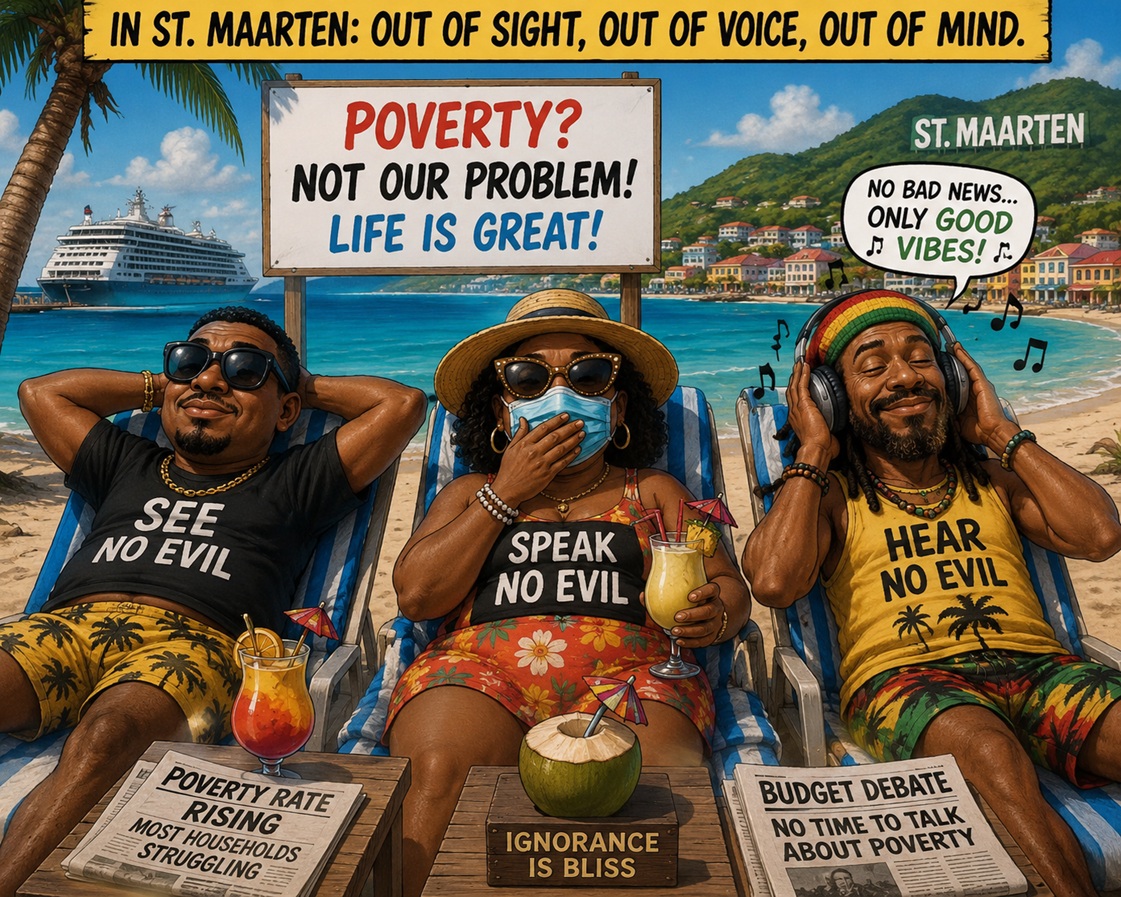
There is perhaps no greater paradox in Sint Maarten than this: if the Sint Maarten Anti Poverty Platform (SMAPP) is even remotely correct in its analysis, then the majority of our electorate is struggling to make ends meet. Yet poverty has never become the defining issue of a general election.
How is that possible?
How can thousands of households reportedly be unable to meet their basic needs, while election campaigns continue to revolve around personalities, political alliances, jobs, road repairs, permit disputes and promises of “change” that rarely address the most fundamental question of all: Can people actually afford to live in St. Maarten?
That question deserves serious reflection.
The latest work by Drs. Raymond Jessurun, Claire Elshot Aventurin and the Sint Maarten Anti Poverty Platform is not merely another policy paper. It is an attempt to fundamentally change how we judge our government. Their argument is straightforward. A country budget should not only tell us whether government balances its books. It should also tell us whether households can balance theirs.
Whether one agrees with every calculation in SMAPP’s research is almost beside the point.
Their work forces us to ask questions that have been absent from our political discourse for decades.
The Silence of the Majority
If thousands of families struggle every month to pay rent, buy groceries, keep the lights on and afford healthcare, why has poverty never become the decisive election issue?
In most democracies, politicians ignore the concerns of the majority at their own peril.
Yet in Sint Maarten, election after election passes without a mass movement demanding that candidates present a credible plan to reduce poverty.
That silence is remarkable.
It is even more remarkable considering that SMAPP has, on previous occasions, attempted to persuade election candidates to sign public declarations committing themselves to fighting poverty once elected. Those efforts have received publicity over the years, including on StMaartenNews.com. Yet the initiative never gained the political momentum one might expect if poverty truly affects such a large share of the population.
Why?
Where Are the Trade Unions?
Equally puzzling is the limited political influence of organized labour.
Claire Elshot Aventurin brings decades of experience as a trade union leader to this discussion. Throughout the world, labour unions have historically been among the strongest advocates for higher wages, better working conditions and social justice. In many countries, they have helped shape national politics by mobilizing workers behind candidates committed to improving living standards.
That has never truly happened in Sint Maarten.
To the best of my recollection, the last prominent trade union figure to successfully make that transition into elected office was Rene Richardson of the Democratic Party, who served as Commissioner of Labour during the Island Territory era of the Netherlands Antilles.
Since then, unions have often spoken forcefully on labour issues, but they have not translated that influence into sustained electoral power.
Why have union members never united behind candidates whose primary mandate would be to tackle poverty, improve wages and strengthen social protections?
Surely, if thousands of working families struggle financially, there should be sufficient electoral strength to make poverty reduction a central political platform.
Is Poverty Still a Taboo?
Perhaps the uncomfortable truth is that Sint Maarten has never been willing to admit the extent of poverty within our own society.
We celebrate luxury villas, mega yachts, private jets and high end tourism. Those industries are important and contribute significantly to our economy.
But they also shape our perception of ourselves.
We like to believe we are prosperous because wealth is visible.
Poverty, on the other hand, is often hidden.
It hides behind families sharing overcrowded homes. It hides behind parents skipping meals so children can eat. It hides behind unpaid utility bills, mounting debt, multiple jobs and people surviving month to month without any financial security.
Many of those living in hardship are employed. They simply do not earn enough to meet the rising cost of living.
That is a very different picture from the one often presented to the outside world.
Rich Compared to Whom?
International reports can sometimes add to the confusion.
The World Bank and other international institutions frequently classify Sint Maarten as a high income economy based on national income indicators and gross domestic product per capita.
Those are useful macroeconomic measurements.
But they do not necessarily describe how people actually live.
A country can have a relatively high average income while simultaneously experiencing severe income inequality and a high cost of living.
If a teacher, security guard, retail worker or pensioner cannot comfortably afford housing, groceries, healthcare, transportation and utilities, then being labelled a “high income country” offers little comfort.
The real question is not whether Sint Maarten appears wealthy on paper.
The real question is whether ordinary households can live with dignity.
A Debate Long Overdue
Whether SMAPP’s estimates ultimately prove to be exactly right or require refinement is something that deserves careful examination. Their figures should be independently verified, challenged where necessary, and debated openly. That is how sound public policy is made.
But dismissing the discussion altogether would be a mistake.
The broader issue they raise is too important to ignore.
For years, politicians have promised economic growth.
Perhaps it is now time to ask a different question.
Has that growth translated into a better quality of life for the average household?
If not, why not?
If poverty is as widespread as SMAPP believes, then poverty eradication should not be treated as a charitable initiative or a political slogan. It should become one of the central objectives of public policy.
The greatest measure of a country’s success is not the number of tourists it welcomes, the value of its GDP or whether its national budget is balanced.
It is whether the people who call that country home can build stable lives, raise their families with dignity and look toward the future with confidence.
Perhaps the greatest achievement of the Sint Maarten Anti Poverty Platform is not the figures it has calculated.
Perhaps it is forcing us to ask questions that we should have been asking ourselves a very long time ago.
###
Related news: SMAPP Calls for Poverty to Become a Measurable Budget Priority
###
ADVERTISEMENT