Advertisement





by The Wayfinder
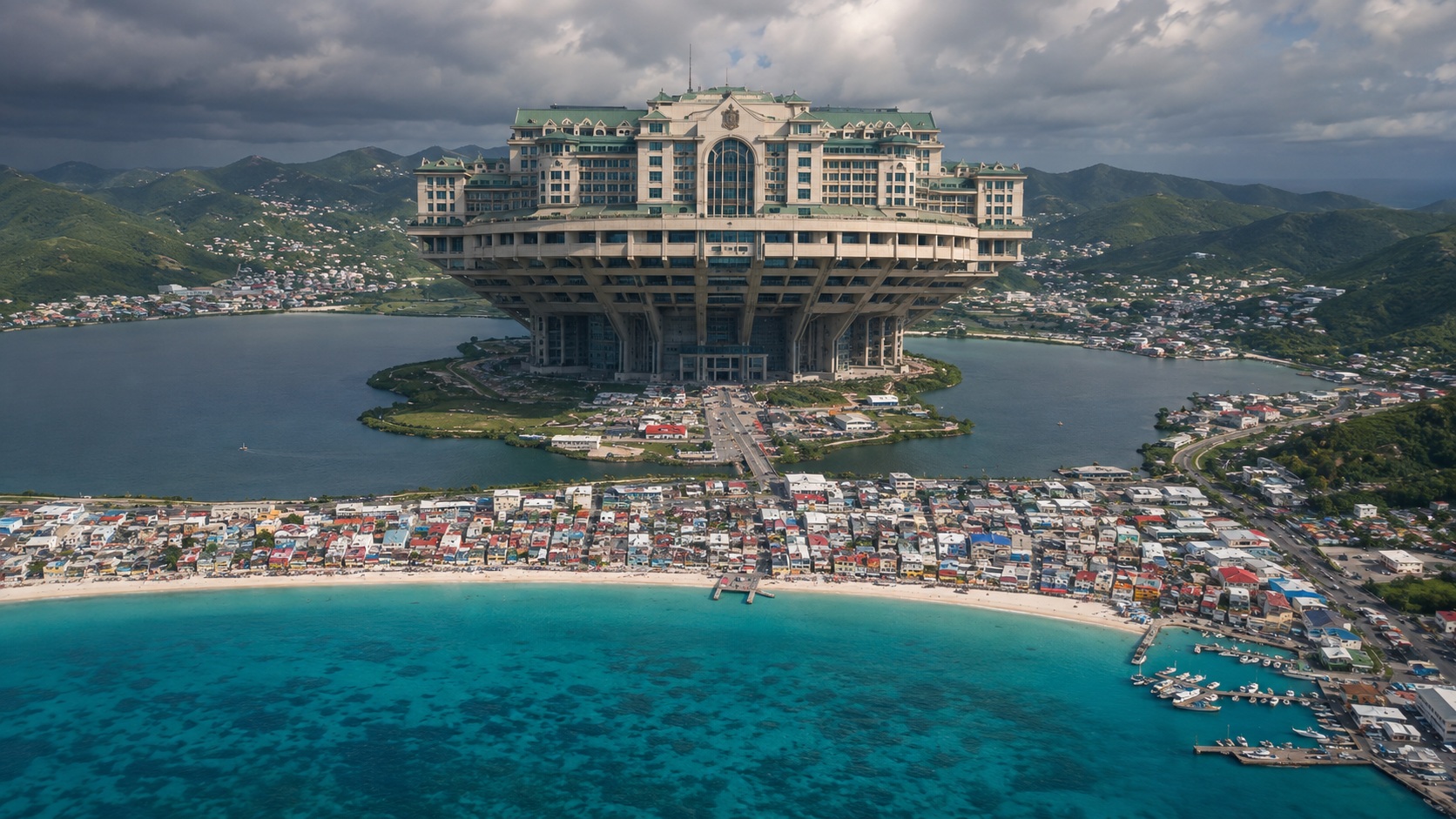
Sint Maarten has a problem that nobody likes to talk about. It is a country. But by almost every practical measure, it is the size and scale of a small city. That is not an insult. It is arithmetic. And arithmetic has an irritating habit: it does not care about feelings.
Sint Maarten has many of the responsibilities of a country. The challenge is not to deny either one. The challenge is to organize accordingly. Pretending the challenge does not exist will not make the bill disappear.
That bill for all this machinery must be paid by the population and economy of a very small territory. Can a small population afford to operate a full-scale government in the same way a large country does? That creates a question which should be asked before every new budget is written.
Sint Maarten cannot afford inefficiency. The smaller a country, the more expensive inefficiency becomes. Every unnecessary department costs more. Every duplicated function is more expensive. Every unnecessary trip is more visible. Every poorly managed government-owned company represents a risk.
Every bad decision has fewer taxpayers available to absorb the consequences. The smaller a country, the less it can afford waste.
Being small should not be seen as a disadvantage. It should actually be a reason to become smarter. Smallness can be an advantage. But…, only if government and parliament stop trying to look bigger than it needs to be. Sint Maarten should think like a nation. It should protect its identity. Defend its interests. Make its own strategic choices. It should think like a nation, but it should operate with the efficiency of a SMART city.
One should avoid constitutional and academic language and turn this observation into a simple and maybe slightly uncomfortable proposition that is the one truth around which everything else revolves.
From a private business point of view, if a company were repeatedly unable to produce reliable accounts, had difficulty meeting financial obligations, depended on refinancing, and carried major contingent risks from troubled subsidiaries, the board would not simply continue business as usual. It would enter a restructuring process.
If this company were facing the financial difficulties Sint Maarten faces today, what would happen? In the USA, the company might seek protection under Chapter 11. In Europe, administrators or restructuring specialists might be called in under commercial court supervision.
They would ask the essential question: “How bad is it, really?” The objective is to stop the bleeding and determine which parts of the organization create value and which parts consume it.
Every book would be opened. Every debt would be counted. Every obligation would be examined. Every loss identified. Every unnecessary expense would be questioned. Every vacant position examined. Every trip justified. Every consultant challenged. And…, every subsidiary inspected. The latter means that every government-owned company will be asked to prove that it deserves to survive.
No new ambitious project should be announced if it is not proven to be essential instead pretended to be essential.
That is not cruelty. That is management. The hardest question of all would be: are we trying to save the organization, or merely preserve the way it has always operated?
Education, healthcare, security and essential infrastructure shall remain protected.
Government must stop behaving as though the problem is a temporary shortage of money and must recognize that it may be a structural problem in the way the country finances, manages and governs itself. Every guilder spent must either protect an essential service, prevent a larger future cost, or produce measurable economic value.
Which brings one to the annual budget. Because the smaller a country, the less it can afford to act bigger than its wallet. The budget is not a Christmas list. One cannot balance a budget by balancing optimism against arithmetic.
Making a budget becomes a problem when the budget stops being a financial plan and becomes a political wish list.
The purpose of a budget is not to prove that government can afford its wishes. The purpose is to force government to choose between them. A budget forces choices and those choices are uncomfortable, especially when everyone wants more, but the country can afford less.
One cannot continue spending yesterday’s confidence when tomorrow’s money has not yet been earned. The objective should not be to shrink government for the pleasure of shrinking it. The objective should be to make government capable of paying for the things a government absolutely must do.
“Do more with less” which means having the courage to stop spending resources on things that produce little or nothing. In other words, do less of what doesn’t matter. Some things must change. Some things must stop. Less theatre. More performance. Some sacred cows may have to learn how to swim.
In a budget, actual income should determine spending and spending should not determine imaginary income. One fundamental danger in creating a budget is that optimism is politically more convenient than honesty.
About The Wayfinder
A Wayfinder defines a role rather than a person. A Wayfinder is not a leader, a politician, or a critic. A Wayfinder asks questions, studies patterns, and searches for the safest and wisest course ahead. These essays are offered in that spirit—not as answers, but as invitations to think together.
###
Related articles:
St. Maarten has jobs and jobseekers. Where Is the Matchmaker?
Truth before popularity. Accuracy before fashion
St. Maarten doesn’t need cheerleaders
Destinations Are Now Parking Lots for Cruise Ships
Caribbean Unity or Cruise Dependency? The Time to Decide Is Now
###
ADVERTISEMENT