Advertisement





Opinion

By Terrance Rey
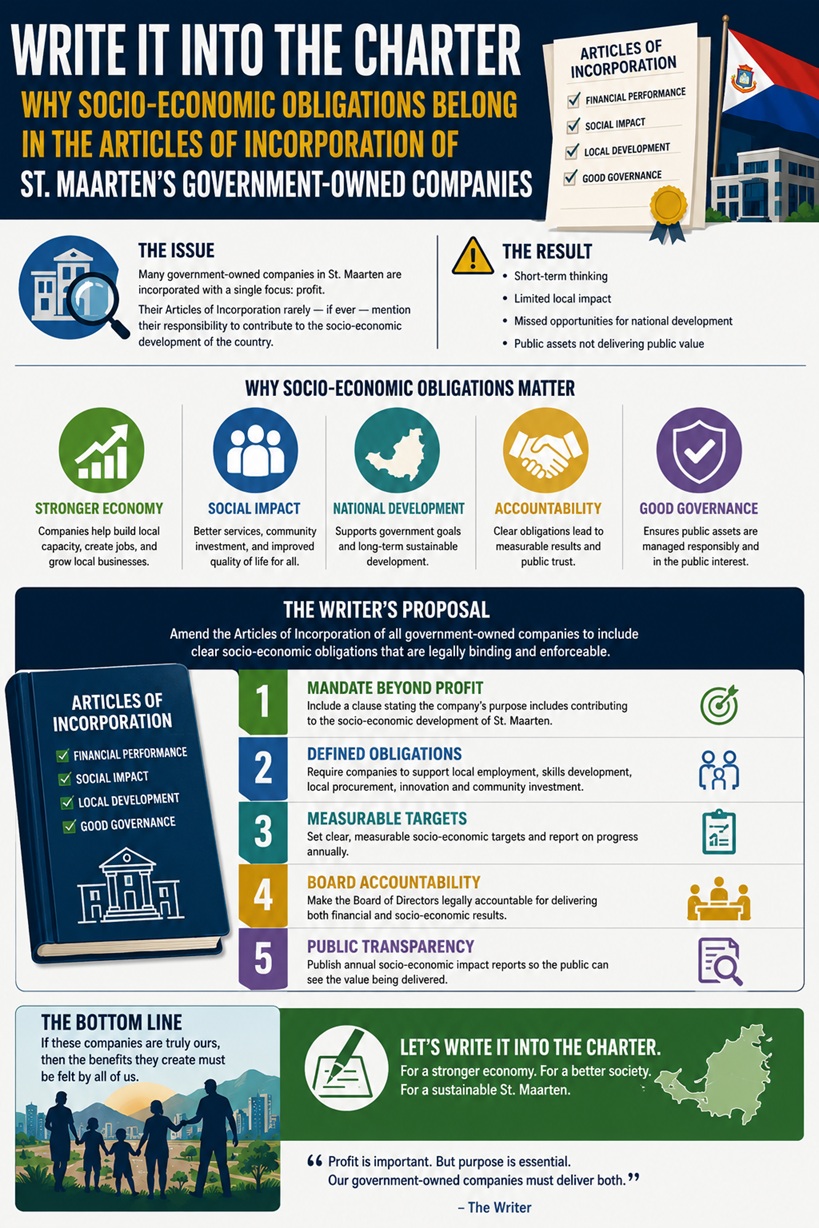
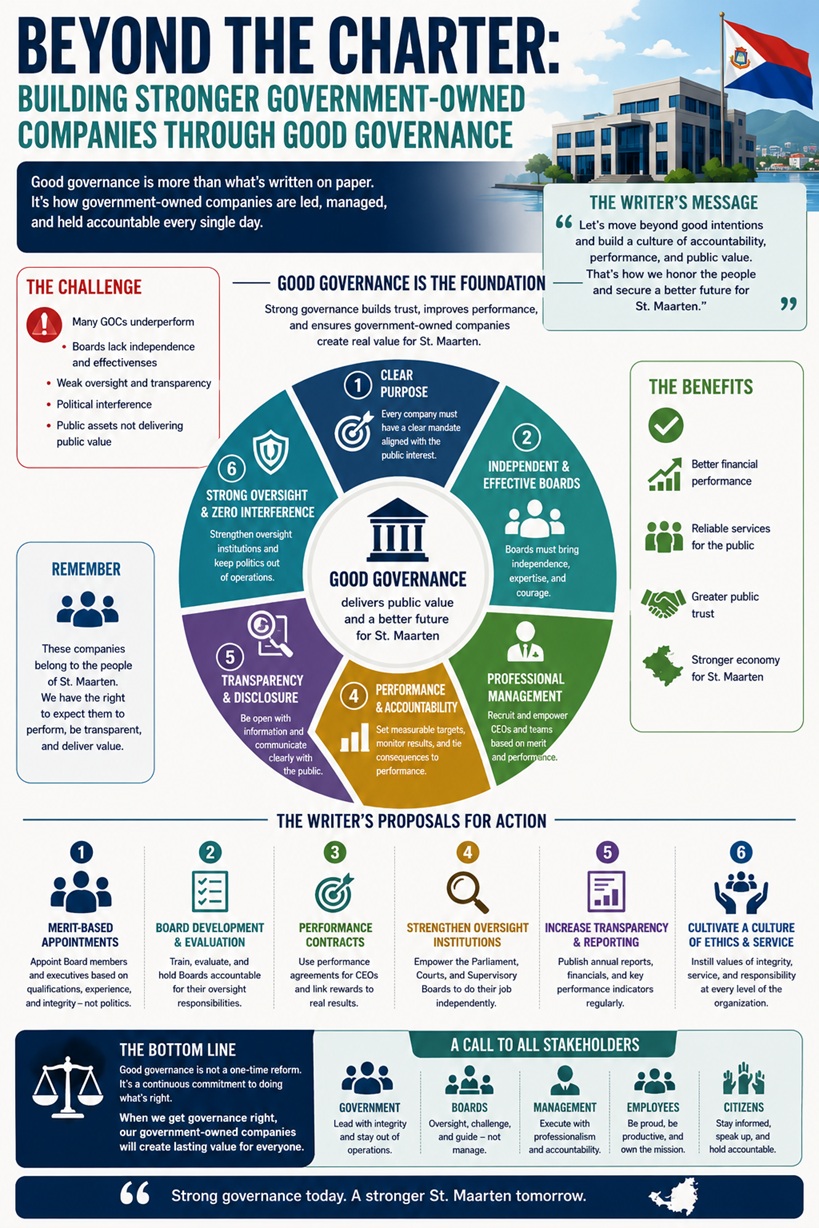
Over the past few days, readers have been treated to two thoughtful opinion pieces published on The Peoples’ Tribune examining the future of St. Maarten’s government-owned companies.
The first article by Regina Labega argues that socio-economic obligations should be written directly into the Articles of Incorporation of government-owned companies. The second article by Franklin Richards contends that good governance ultimately depends less on what is written in legal documents and more on competent boards, professional management, transparency and accountability.
After reading both articles carefully, my conclusion is simple.
They are both right.
But neither article fully answers the question the average citizen is asking.
Most people are not interested in Articles of Incorporation.
Most people are not interested in governance frameworks.
Most people simply want to know why government-owned companies continue to consume public resources while too often failing to deliver the level of service, efficiency and economic value that the country deserves.
That is the real debate.
Governance is a Means, Not the End
Too often governance discussions become exercises in legal drafting or corporate theory.
Governance is not the objective.
Results are.
Good governance is valuable only because it produces better decisions.
Better decisions produce stronger companies.
Stronger companies produce better public services.
Better public services improve people’s lives.
If governance reforms fail to improve those outcomes, then they are simply paperwork.
The Missing Piece
Both authors discuss governance.
Neither spends enough time discussing performance.
A government-owned company should not exist merely to balance its books.
Nor should it exist merely to satisfy governance checklists.
Its existence must create measurable value for the country.
Every government-owned company should therefore answer several straightforward questions every year.
- How much value did we create for St. Maarten?
- How many local jobs did we create?
- How much business did we award to local companies?
- How much did we reduce costs for consumers?
- How did we improve our services?
- How did we contribute to national development?
- Why should taxpayers continue owning this company?
Those questions matter far more than whether another policy manual has been approved.
Articles Matter
The first writer correctly argues that if socio-economic obligations are important, they should not merely exist as political speeches or shareholder expectations.
They should become part of the company’s legal DNA.
There is considerable merit in that argument.
A company that legally exists only to pursue commercial objectives will naturally focus on commercial objectives.
A company whose constitutional documents explicitly recognize broader public responsibilities will have a stronger legal basis for balancing profitability with national development.
That is not social engineering.
That is simply defining the purpose of public ownership.
Governance Matters
The second writer is equally correct.
No constitutional document can compensate for poor leadership.
A brilliant Articles of Incorporation cannot rescue an incompetent board.
Likewise, an outstanding board cannot indefinitely overcome vague mandates, political interference or unclear shareholder expectations.
Good governance requires capable people.
Competent people require clear rules.
Both are essential.
But There Is an Even Bigger Question
Perhaps the debate should go one step further.
Why do we own these companies in the first place?
Government ownership is not supposed to create jobs for political supporters.
Nor should it create comfortable positions for directors.
Government ownership exists because these companies perform functions that are strategically important to the country.
If that is true, then every government-owned company should have a clearly defined national mission.
Not simply a business plan.
A national mission.
Every strategic decision should be evaluated against that mission.
Parliament Must Become More Involved
Corporate governance should not become an excuse for Parliament to disengage.
On the contrary.
Government-owned companies manage public assets.
They therefore deserve meaningful parliamentary oversight.
Not political interference.
Oversight.
There is a profound difference.
Parliament should continuously evaluate whether these companies are achieving the national objectives established by the shareholder on behalf of the people of St. Maarten.
The Conversation We Should Be Having
Rather than asking whether one author is correct and the other mistaken, perhaps we should recognize that they are examining different layers of the same issue.
One focuses on the company’s legal foundation.
The other focuses on the company’s operational culture.
Both matter.
But there is a third layer that deserves equal attention.
Performance.
Ultimately, citizens judge government-owned companies by outcomes, not governance models.
Reliable electricity.
Affordable water.
Efficient airport operations.
Strong telecommunications.
Modern infrastructure.
Financial sustainability.
Excellent customer service.
Those are the metrics people experience every day.
My Proposal
If I were redesigning the governance model for every government-owned company in St. Maarten, I would combine both authors’ recommendations into one integrated framework.
First, define the national mission in the Articles of Incorporation.
Second, appoint independent, qualified and accountable boards.
Third, establish measurable annual performance indicators that include both financial performance and socio-economic impact.
Fourth, require every company to publish an annual Public Value Report explaining exactly what benefits it delivered to the people of St. Maarten.
Finally, evaluate directors and management not only on profits but on whether they fulfilled the national mission for which the company exists.
That, in my view, is what modern public ownership should look like.
The real question is not whether governance begins with the charter or with the boardroom.
The real question is whether every decision made inside these companies ultimately serves the people who own them.
Because they do have owners.
The shareholders may legally be the Government of St. Maarten.
But morally, economically and democratically, the true owners are the people of this country.
###
Referenced articles:
Infographic to explain the article’s concepts:
Infographic to explain the article’s concepts:
###
ADVERTISEMENT