Advertisement





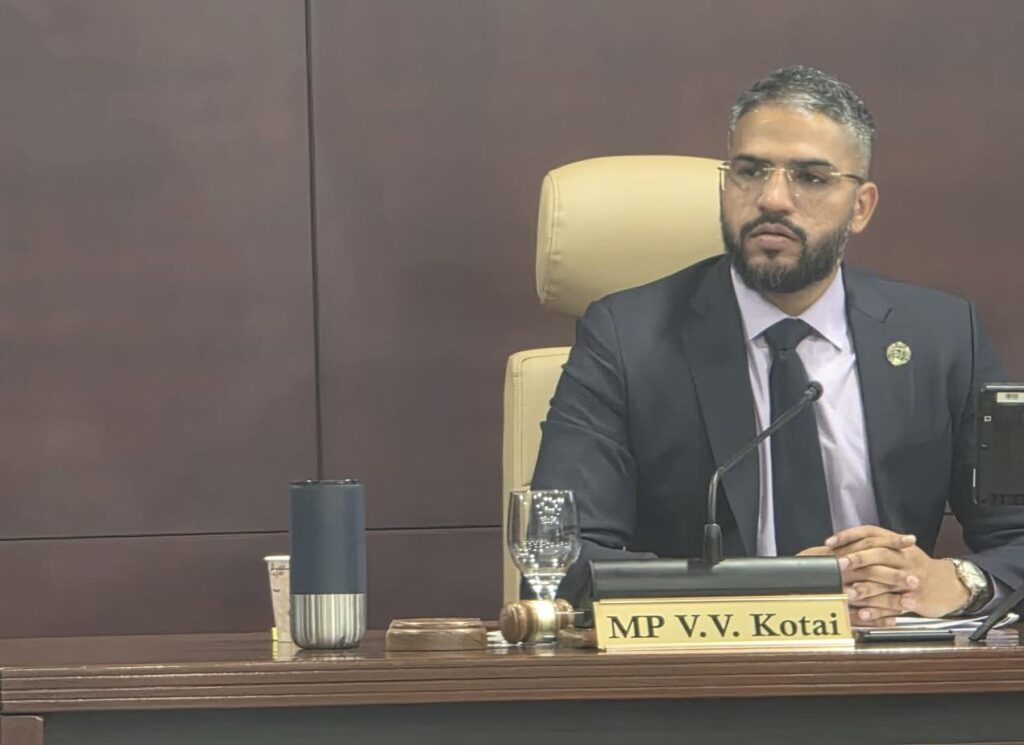
Legal and financial uncertainty surrounding the future of the monetary union between Curaçao and St. Maarten took center stage in Parliament on Tuesday. Member of Parliament Viren Kotai, representing the Democratic Party (DP), pressed for clarity on whether either country can independently withdraw from the arrangement and what the consequences would be.
His intervention followed a candid presentation by DP Minister of Finance Marinka Gumbs, who outlined growing tensions within the monetary union between Curaçao and St. Maarten and raised concerns about structural imbalances within the Central Bank of Curaçao and St. Maarten (CBCS).
With reports that Curaçao may be considering a departure from the monetary union, MP Kotai sought to establish whether such a move could be undertaken unilaterally and under what legal framework.
Kotai did not limit his concerns to legal theory. He went on to outline a series of practical and financial risks that could arise should the union be altered or dissolved, particularly in relation to the role and responsibilities of the CBCS.
One of the key issues raised was the cost already borne by the CBCS and, indirectly, by the people of both countries. Kotai pointed to the approximately 15 million guilders spent on the transition from the Netherlands Antillean guilder to the Caribbean guilder. “While this remains an operational cost of the CBCS, it is clearly understood that these costs indirectly affect the people of St. Maarten and Curaçao,” he said.
He also questioned how long-standing commitments would be honored in the event of institutional change, including the Central Bank’s obligation to accept old Antillean banknotes for up to 30 years.
The uncertainty surrounding these obligations, he suggested, could create financial and administrative complications if the current structure is disrupted.
ENNIA resolution concerns
Kotai devoted significant attention to the ENNIA insurance resolution, a long-term financial commitment stemming from the company’s collapse in 2018.
Under the 50-year agreement, St. Maarten is expected to contribute approximately 2.3 million guilders annually starting in 2027, amounting to some 115 million guilders over time. Curaçao, by comparison, is contributing 30 million guilders per year. The CBCS itself is also expected to contribute 15 million guilders annually to the resolution fund.
“If the role of the CBCS is changed or moved, who assumes responsibility for this annual contribution?” Kotai asked. He further noted that the resolution involves a deficit of approximately one billion guilders, raising questions about who would continue recovery efforts and pursue accountability if the central bank’s authority is weakened or dissolved.
Kotai also highlighted concerns about assets currently under CBCS oversight, including the Mullet Bay property in St. Maarten. The property, linked to the ENNIA restructuring, remains a significant national asset. “How will any restructuring or dissolution of the CBCS impact the timing, control and valuation of this critical national asset?” he asked.
The MP also raised questions about the Central Bank’s investment strategy, including reports that roughly 30 percent of its gold reserves were sold in 2024 and reinvested in fixed-income instruments.
“Given the rise in gold prices since then, did this decision yield stronger returns or did it result in lost opportunity value?” Kotai asked, noting that such decisions directly affect dividend payments to St. Maarten.
Call for strategic debate
Kotai concluded by calling for a broader, structured discussion on the country’s monetary future, including the option of dollarization. “I respectfully request… a formal parliamentary debate on dollarization versus retaining the guilder, supported by independent and politically unaffiliated consultancy firms presenting opposing views,” he said.
Kotai’s questions followed a frank assessment by Finance Minister Gumbs, who acknowledged longstanding concerns about the functioning of the monetary union.
“In my own assessment, Curaçao has benefited more from the CBCS than St. Maarten,” she told Parliament, citing Curaçao’s larger financial sector, greater policy influence, and the fact that the bank’s headquarters and operations are largely based there.
According to Gumbs, this imbalance was tolerated for years but became increasingly visible as St. Maarten began asserting its right to equal treatment. “That imbalance was tolerated for some time. But once St. Maarten began to demand equality as envisaged in the statute, the divisions became more glaring,” she said.
The minister also confirmed that Curaçao has expressed interest in pursuing greater monetary autonomy. “Curaçao has expressed a desire to control its own monetary policy, set its own interest rates and manage its own currency.”
Despite the uncertainty, Gumbs stressed that St. Maarten would approach any potential changes with caution and preparation. “We will answer the door knowing fully well that any dismantling has to be deliberated, legally structured and financially fair,” she said.
She emphasized that the country would not be pressured into decisions that could undermine its financial stability. “We will not be rushed. We will not be sidelined. We will not be bullied. We will not compromise the interests of our people.”
Framing the issue as one of national importance, Gumbs called for unity and focus. “This moment requires unity, resolve and clarity of purpose. It requires us to stand firm in defense of our national interest,” she said.
The parliamentary meeting ended without immediate responses to the detailed questions raised by Kotai and other MPs. A follow-up meeting is expected in two weeks, during which the minister will return to Parliament to provide further clarification.
###
ADVERTISEMENT