Advertisement





 ~ Statistician’s Report Finds Rising Utility Costs Affecting Household Behavior, Public Confidence and Economic Resilience ~
PHILIPSBURG, Sint Maarten — A newly released technical report prepared by local statistician Shandrika Octavia Peterson, M.Sc. Mathematics & Statistics, has transformed a community electricity survey into one of the most detailed statistical examinations to date of how residents are experiencing electricity affordability and utility reliability in Sint Maarten.
Peterson, who holds a Master of Science degree in Mathematics and Statistics from the University of Miami, conducted a comprehensive analysis of the 2026 Sint Maarten Community Electricity Survey, an anonymous survey that collected approximately 201 responses from residents, apartment tenants, homeowners and small business operators across the country during May 2026.
In a letter addressed to Members of Parliament, Peterson emphasized that the report was developed as an independent community research initiative intended to contribute constructively to public discussion surrounding electricity affordability, utility reliability, household adaptation behaviors and long-term sustainability concerns. She stressed that the report was not political in nature and was not intended to assign blame.
More Than a Survey
While the public report previously highlighted basic findings, the technical report expands the analysis considerably by applying descriptive statistics, exploratory subgroup analysis, inferential testing and the creation of an experimental Energy Vulnerability Index (EVI).
Among the most striking findings:
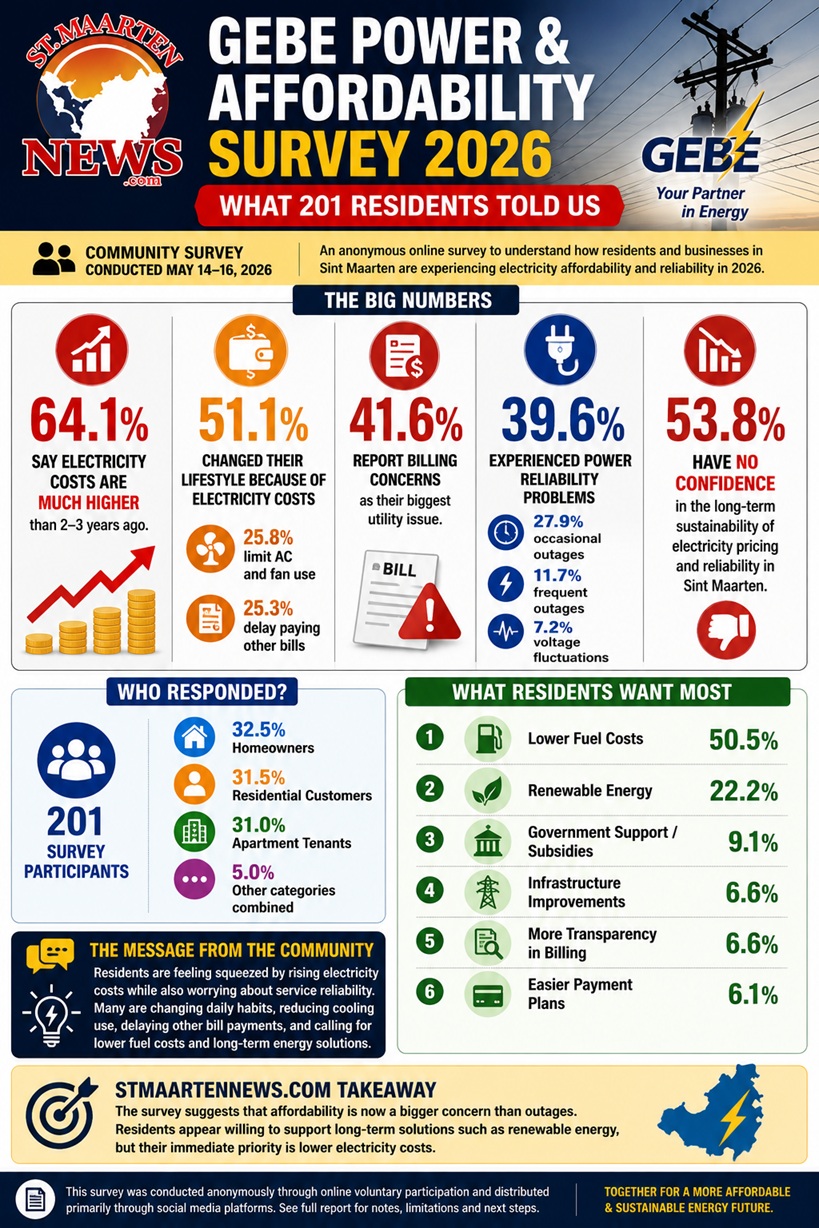
- 64.1% of respondents reported electricity costs are “much higher” than two to three years ago.
- More than half of respondents reported low confidence in the long-term sustainability of electricity pricing and reliability.
- Many households reported adapting their behavior by limiting air-conditioning use, delaying payment of other bills, reducing grocery spending or borrowing money.
- Billing concerns emerged as one of the most frequently reported utility-related complaints.
According to Peterson, these findings suggest electricity affordability is increasingly being viewed not simply as a utility issue but as a broader household economic challenge affecting quality of life, financial stability and long-term resilience.
Aging Population Adds New Dimension
One of the report’s more interesting contributions is its discussion of how utility affordability may affect different generations differently.
The analysis notes that Sint Maarten’s population is gradually aging and highlights concerns that older residents may face heightened vulnerability because of fixed incomes, increased exposure to heat, medical dependencies and reduced financial flexibility.
At the same time, working-age residents often shoulder responsibility for supporting children, elderly relatives and multi-generational households. Rising utility costs may therefore have ripple effects throughout entire family structures.
A Statistically Significant Finding
Perhaps the most noteworthy technical finding emerged from Peterson’s exploratory inferential analysis.
Using a chi-square test, the report found a statistically significant relationship between age category and the primary coping strategy households use to manage electricity affordability pressures (χ²=11.74, p=0.0385).
In practical terms, this suggests that different age groups appear to respond differently when faced with rising electricity costs.
Older respondents were more likely to limit cooling usage and avoid appliance use, while younger and working-age respondents were more likely to delay paying other bills or borrow money.
However, Peterson carefully cautions that because the survey relied on voluntary participation rather than random sampling, these findings should be interpreted as exploratory rather than definitive population-wide conclusions.
Energy Vulnerability Index
Another innovative aspect of the report is the introduction of an exploratory Energy Vulnerability Index (EVI).
The framework attempts to classify household coping behaviors into varying levels of vulnerability based on how respondents adapt to rising electricity costs. The analysis found:
- 10.1% displayed lower vulnerability indicators.
- 40.4% displayed moderate vulnerability indicators.
- 49.5% displayed higher vulnerability indicators.
Households categorized in the higher vulnerability group were more likely to report delaying bill payments, reducing grocery spending or borrowing money in order to cope with utility costs.
Peterson emphasizes that the index is exploratory and not intended as a formal poverty measurement, but it offers a framework for understanding how electricity costs may influence broader household economic decisions.
What Residents Want
When respondents were asked what would help most, the answers were remarkably consistent.
The top priorities identified were:
- Lower fuel and energy costs.
- Renewable energy expansion.
- Government support measures.
- Infrastructure improvements.
- Greater billing transparency.
- Easier payment plans.
The report interprets these responses as evidence that residents are interested not only in short-term affordability relief but also in long-term structural solutions involving energy diversification and infrastructure modernization.
Message for Parliament
The report concludes with several policy-relevant observations that may warrant further discussion among government officials, NV GEBE, regulators and Parliament.
Among them are:
- The need to better understand household energy burden.
- Additional research into affordability thresholds.
- Examination of impacts on elderly and vulnerable populations.
- Infrastructure resilience assessments.
- Renewable energy feasibility studies.
- Improved public communication and billing transparency.
Peterson repeatedly stresses that the survey should not be viewed as a regulatory audit or scientific census of the entire population. Instead, it should be regarded as an exploratory snapshot of community experiences and perceptions that may help guide future research and policy discussions.
A Conversation Worth Having
Whether one agrees with every interpretation contained in the report or not, the technical analysis succeeds in elevating the discussion beyond anecdotal complaints and social media frustrations.
The report provides statistical evidence that many residents perceive electricity affordability, reliability and billing concerns as significant challenges. It also highlights how these issues may intersect with broader questions of household stability, economic resilience and public confidence.
As Sint Maarten continues debating the future of its energy sector, Peterson’s report may serve as an important starting point for a more evidence-based conversation about affordability, sustainability and the long-term resilience of the country’s utility infrastructure.
###
ADVERTISEMENT