Advertisement





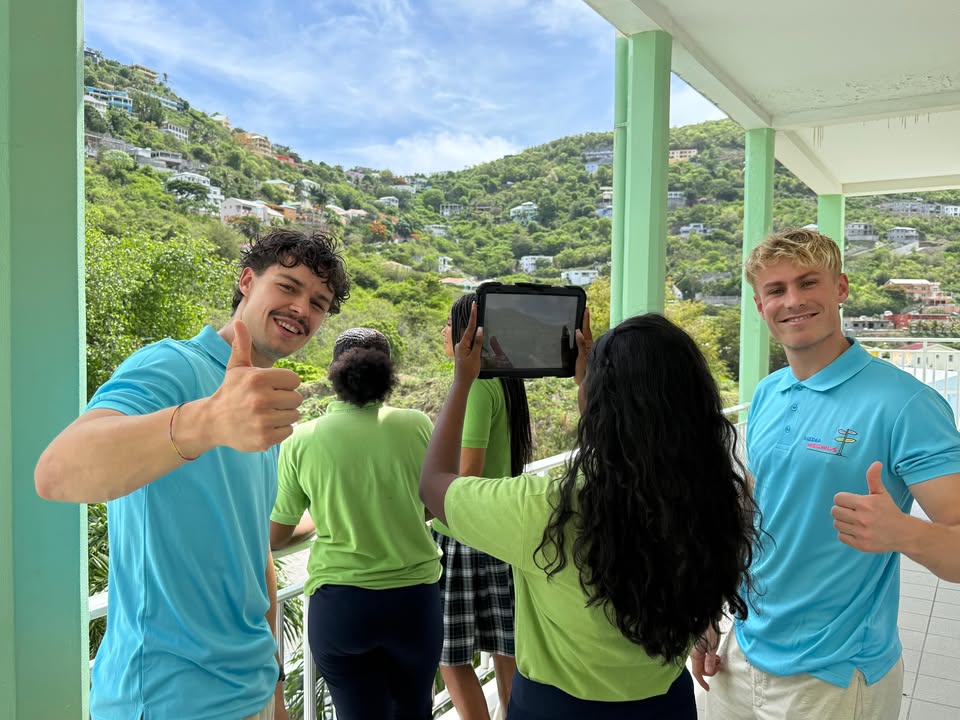
SINT MAARTEN – Holding a camera is one thing; telling a story with it is something else. Looking through a VR headset is more than just fun. And a video on social media is not always what it seems. This week, a project by Mediawegwijs and Stichting EGO kicked off in Sint Maarten. Young people from different schools are exploring filmmaking and media literacy, as well as topics such as AI, fake news, privacy, influencers and online identity. Not by learning from a textbook, but mainly by doing and experiencing it themselves.
The first day began with a warm welcome. During Dominic High School’s regular weekly assembly, attended by around 400 students, Mediawegwijs and Stichting EGO were invited on stage and officially welcomed. Then it was time to turn on the cameras. The young participants learned various filming techniques and discovered how different camera shots can influence the story you tell. They practised these techniques and then created a storyboard for their own film.
They will use these skills throughout the coming year for ‘Film Your Life’, the part of the project delivered by Mediawegwijs. The young participants will capture their own lives in Sint Maarten: the places they like to spend time, the people who matter to them and moments from their everyday lives. Images you are unlikely to see in a typical holiday video of the island. Step by step, ‘Film Your Life’ will grow into a personal portrait of Sint Maarten, seen through the eyes of its young people.
Part of a larger year-long project
‘Film Your Life’ is part of A Step Beyond, a year-long project by Stichting EGO led by Ria Uiterloo. Running until June 2027, the programme brings together digital literacy, AI, filmmaking, robotics, creative technology and social-emotional learning. Uiterloo is the driving force behind the initiative and has brought together several partners, including Mediawegwijs and NIA, the National Institute of Arts.
A special visitor in the classroom
The first day also brought a special visitor. Sint Maarten’s Minister of Education, Culture, Youth and Sport, Melissa Gumbs, joined the group and stayed for almost an hour to attend one of the lessons on AI. Afterwards, the conversation turned to the importance of this type of education and what lessons in digital and media literacy could mean for schools and students across Sint Maarten. Gumbs is the current Minister of Education, Culture, Youth and Sport.
Editing changes the way you look at media
Over the coming days, the young participants will also discover what happens after filming. By selecting and editing footage themselves, they will experience how easily the meaning of a video can be influenced. Leaving out a clip, changing the order or adding music can create an entirely different story. In this way, a lesson in editing also becomes a lesson in media literacy.
“I pay more attention to the videos I see online now. Because the person making the video decides what you do and don’t get to see.” Nathan, 13
Online content is also part of the conversation. Why does one video get shared thousands of times while another does not? When do you believe something you see on social media? And how do you know whether a photo or video is real? According to Ilse Godtschalk, educational specialist and director of Mediawegwijs, these are exactly the kinds of conversations that arise when young people do not just consume media, but start creating it themselves.
“The moment they stand behind the camera themselves, they realise how many choices they make. Then you can turn the question around: if you can use images to shape a story, what does that mean for all the videos you see in your own feed every day?”
Finding their way in a digital world
Lessons taught by Mediawegwijs educators Kay and Biko connect directly with the digital world the young participants encounter every day. Rather than simply telling them what they should or should not do, the lessons encourage them to investigate, create and experience things for themselves. They discover how easily images can create a particular impression, what happens to their data online and what role AI plays in the information they encounter.
Throughout the programme, topics include fake news, screen use, cookies and privacy, game design, influencers, online identity and self-image. The programme also covers interviewing techniques, vlogging and podcast production. The project therefore goes beyond developing digital skills: it also teaches young people to engage with media and technology consciously and critically.
And in the afternoon? It’s the teachers’ turn
While the young participants get to work in the mornings, the afternoons are dedicated to teachers, school directors and other education professionals from different schools across Sint Maarten. During the train-the-trainer sessions, they experience for themselves how filmmaking, media literacy and digital literacy can be brought into the classroom in an engaging and practical way.
These are not presentations where participants simply sit and listen. They explore lessons, try out assignments and discover how topics from young people’s digital lives can be incorporated into their own teaching.
Mediawegwijs’s English-language school portal provides them with the lessons and practical tools they need to continue independently afterwards.
One school director told the Mediawegwijs educators that she was particularly pleased that Mediawegwijs provides a ready-to-use learning pathway for digital literacy, AI literacy and media literacy. Schools do not have to reinvent the wheel: they can implement the programme directly, including the learning objectives they want to achieve with their students.
Another education professional, who had also attended the morning programme, was struck by how engaged the students were:
“The students were incredibly engaged during the lesson on AI, but also during the lesson on screen addiction. This is their world, and it is our responsibility to guide them through it. Mediawegwijs’s practical approach gives us a way to do that in our own classrooms.”
Plenty more to discover
The first shots have been filmed and the first storyboards are ready, but the programme has only just begun. Over the coming days, the young participants will continue to build on what they have learned, with new assignments and topics added throughout the programme.
The train-the-trainer sessions will continue as well. At the end of the programme, film, creativity and media literacy will come together in the presentation of the film project. But ‘Film Your Life’ does not end there: throughout the coming year, the young participants will continue capturing their own stories of life in Sint Maarten. The participating schools will also receive access to the Mediawegwijs portal, allowing them to continue working with the digital and media literacy curriculum.
Background information
Mediawegwijs brings digital and AI literacy into schools
Mediawegwijs has developed a complete learning programme covering digital literacy, media literacy and digital citizenship for primary and secondary education. The programme was designed to help schools integrate digital literacy into everyday education.
Mediawegwijs specialist teachers deliver lessons at schools throughout the Netherlands and beyond, including Suriname and the Caribbean Netherlands. Thanks to its train-the-trainer approach, teachers are able to continue delivering the lessons independently after the Mediawegwijs specialists leave, using lessons and teaching materials available through an online portal. This is especially important in light of the Dutch national curriculum objectives for digital literacy.
Mediawegwijs also involves parents, creating a complete approach to media education around the child. The aim is to prepare today’s children and young people for their role in tomorrow’s society.
Children are encountering online media at an increasingly young age. Alongside traditional school subjects, it is therefore important that they become digitally and AI literate. This includes learning how to distinguish reliable information from misinformation, understanding both the opportunities and risks of AI, using social media safely, becoming aware of their screen use and knowing how to respond to cyberbullying.
More about Mediawegwijs?
https://mediawegwijs.nl/en/ or download our brochure: https://mediawegwijs.nl/en/download-brochure/
###
ADVERTISEMENT