Advertisement





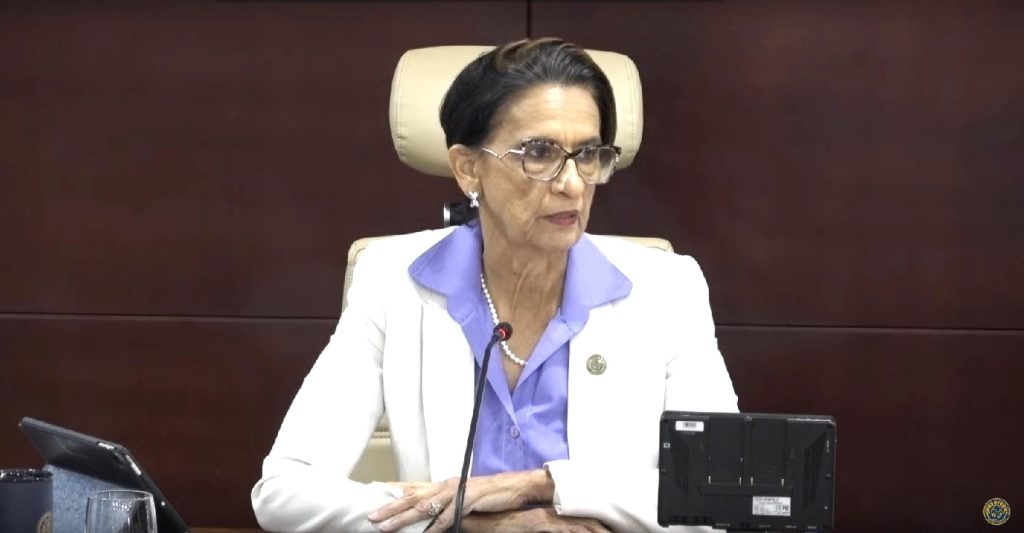
Member of Parliament Sarah Wescot-Williams, leader of the Democratic Party (DP), on Tuesday presented a proposal to establish a Community-driven District Development Fund for St. Maarten, receiving broad support from members of the Committee for District Councils (CDC), which she chairs.
The proposal, aimed at strengthening community participation and decentralizing development efforts, was discussed during a CDC meeting attended by DP MP Dimar Labega, Unified Resilient St. Maarten Movement (URSM) MP Veronica Jansen-Webster, United People’s (UP) party MP Francisco Lacroes, and Nation, Opportunity and Wealth (NOW) party MP Lyndon Lewis. Members expressed general agreement with the initiative.
Wescot-Williams formally requested the committee’s endorsement to explore and pilot the fund, which would support small-scale, community-led projects across districts.
Empowering communities
In outlining the proposal, Wescot-Williams emphasized that district residents and councils would play a central role in identifying and executing projects such as beautification efforts, lighting improvements, playground rehabilitation, and other public amenities.
“These are relatively small investments, but they can have a high and visible impact within communities,” she said. “The residents should feel ownership of the changes in their neighborhoods.”
The fund would promote public-private collaboration, allowing residents, businesses, community groups, and even diaspora supporters to contribute financially or in-kind to specific district initiatives. Oversight would initially be provided by the St. Maarten Development Fund (SMDF), ensuring transparency, accountability, and proper financial management.
Wescot-Williams also stressed the importance of clear reporting mechanisms, such as public dashboards or regular updates, to track project progress and funding. “We need to make sure that everyone can see what’s happening in their community. Transparency is key.”
Building on past initiatives
Wescot-Williams recalled that similar initiatives had roots in post-Hurricane Luis reconstruction efforts in the 1990s, where small grants for community-led projects proved highly effective in fostering local ownership and responsibility. This inspired her, during her tenure as Prime Minister from 2010 to 2014 to establish community help desks and public service centers.
She further highlighted the Foundation-Based Education (FBE) model adopted by St. Maarten: “The FBE system, chosen by St. Maarten, was for community schools, meaning a child will be in school from their early start right through the afternoon, and then continue in a community environment, with persons from the community giving training or coaching—all under the umbrella of the school. This is how we combine education with community engagement, giving both the child and the community a stake in development.”
MPs weigh in
MP Dimar Labega welcomed the initiative, highlighting the importance of district engagement: “As representatives of the people, it is our job to stay in touch with the different districts and in the community. Some district councils may be inactive, so this is a great initiative to give them a reason to become active. A proposal like this gives ownership to the district and communities, letting them know that if there’s an issue, no matter how big or small, there is somewhere it can be raised and addressed. Something like this is very important and very necessary.”
MP Francisco Lacroes praised the initiative’s ability to foster pride and accountability in communities: “I like the idea. During the last budget, I brought a motion for St. Maarten to decorate the districts. This proposal falls exactly in line with that, helping to bring back a sense of pride in our neighborhoods. What I would like to see is proper registration and administration of everything done with these funds, ensuring projects are safe, maintained, and truly serve the community.”
MP Lyndon Lewis emphasized the need for a structured framework and proactive community engagement: “I am one of the youngsters that grew up in community centers with different programs, so I understand the importance of having a framework established. Being raised in two different districts—the French and Dutch quarters—there are multicultural communities where people speak different languages, which can create disconnects. Who do they turn to? Who is the representative of the community? That’s why a framework for community councils is crucial—it creates clear contact points, establishes hierarchy, and ensures proactive engagement rather than reactive. Government alone cannot bear this burden; it has to be a joint effort with the business community, politicians, and residents. This is a great initiative, and it has my full support.”
MP Veronica Jansen-Webster asked about the practical steps forward: “If we have something already on paper, at least we can tailor it. There are similarities with the Community Help Desk, so some elements could be adapted for this. I see us being able to get this done in this parliamentary year, especially with at least one pilot.
Wescot-Williams responded to these contributions, noting: “Indeed, I have some ideas. I have looked at structures the Netherlands have for decentralized governance, but we need to tailor it to meet our local needs. There are already initiatives within the SMDF to organize community councils, and the legislative part will be up to us.”
Next steps
The CDC Committee of Parliament agreed to move forward with the proposal, including formally inviting the SMDF to Parliament to discuss existing and potential initiatives aligned with the concept.
Wescot-Williams indicated that the next phase will involve developing a practical framework and pilot plan, with the aim of launching at least one pilot project as early as 2026. “I don’t want this to remain just a good discussion. We need to take this step by step and ensure it leads to real results,” she said.
###
ADVERTISEMENT