Advertisement





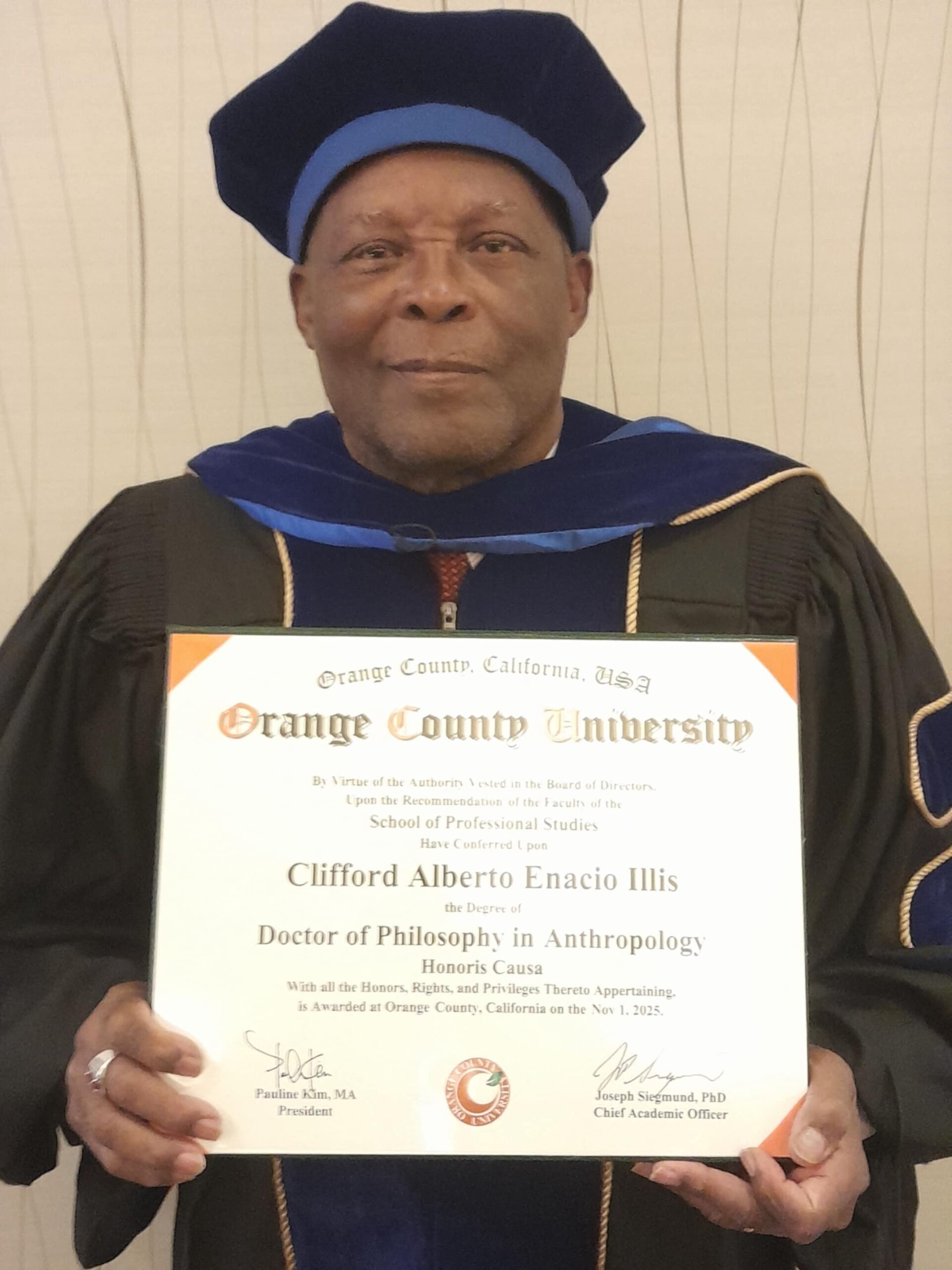
Sint Maarten has long been a place where vibrant cultures, diverse histories, and modern challenges intersect. Now, one of its own is stepping forward with a unique academic lens to deepen our understanding of everyday life on the island — from labor disputes to community dynamics and public policy.
Dr. Clifford Alberto Enacio Illis, recently honored with a Doctor of Philosophy in Anthropology from Orange County University (USA), will be contributing a regular series to StMaartenNews.com exploring the social and cultural forces shaping life here in Sint Maarten. We posed a series of questions to him to learn more about his background, his motivation, and how his work might help the island navigate its future.
Q: First of all, Dr. Illis — what exactly is Anthropology?
Dr. Illis:
Anthropology is the study of people — their behaviors, beliefs, values, relationships, and the deep stories that give meaning to daily life. It’s about understanding why people act the way they do, not just what they do. Unlike approaches that treat people as numbers or abstract economic agents, anthropology sees culture as central to every decision humans make — from how we organize work, to how we relate to government, to how we care for our children.
Q: Why did you choose to study Anthropology? What drew you to it?
Dr. Illis:
I’ve always been fascinated by the human experience and by contradictions in social behavior — why policies often fail despite good intentions, or why social problems persist even when solutions seem obvious. Studying anthropology gave me tools not just to describe human behavior, but to interpret it within cultural context. It’s a powerful way to bridge lived reality and policy design.
Q: You’re now publishing a series on StMaartenNews.com. How does your training apply to hot-button issues like service charges, tips, and labor rights in Sint Maarten?
Dr. Illis:
Take the recent debate over service charges and gratuities. On the surface, it’s a legal or economic issue. But when you look deeper, you see it’s also about cultural expectations — notions of fairness, hospitality norms, historical labor practices, and trust between customers, workers, and businesses.
Anthropology helps unpack why people think the way they do, so we can design regulations and communication strategies that actually fit the lived experiences of workers and consumers here. It’s one thing to write a law; it’s another to make sure people understand it, trust it, and comply with it.
Q: How can Sint Maarten as a society benefit from anthropological insight?
Dr. Illis:
In several concrete ways:
- Government Policy: How are tax forms, communication materials, and compliance processes interpreted by people of different linguistic backgrounds and education levels? Understanding this can improve participation and fairness.
- Labor & Migration: Insights into family networks, remittance patterns, and informal economies can help create more effective labor protections.
- Media & Public Discourse: By explaining social issues in human terms, we can move beyond finger-pointing and simplistic narratives.
- Youth & Community Programs: Teaching young people to observe, describe, and interpret their surroundings builds civic engagement and critical thinking.
- Business & Culture: Small business owners can benefit from understanding how culture shapes work preferences, customer behavior, and staff relationships.
- Political Reform: Anthropology maps power and social networks, not simply denounces them — which is crucial for realistic and sustainable reform.
Q: How will your work unfold in practical terms here on the island?
Dr. Illis:
My goal is to combine academic perspective with real-world practicality. Examples include:
- A weekly anthropology column on StMaartenNews.com tied to short radio segments and public engagement.
- Workshops in neighborhoods and schools focusing on community mapping and civic engagement.
- Consulting with businesses and government agencies on policies that respect cultural realities.
- Pilot programs — even small projects with measurable results — to demonstrate the value of culturally informed approaches.
Q: What do you hope readers take away from your upcoming contributions?
Dr. Illis:
That culture isn’t an abstract word — it’s the underlying grammar of how we live, work, and make decisions. If we ignore that grammar, even the best policies and ideas fail. My work aims to give Sint Maarteners the language and tools to understand themselves better — not through judgment, but through insight.
Looking Ahead
Dr. Illis’s first article for StMaartenNews.com — a deep dive into labor laws, service charges, and gratuities — has already sparked widespread discussion. In the months ahead, his contributions promise to broaden our collective lens on many of the island’s most persistent social issues.
For updates on his writings and upcoming workshops, follow the Labor & Culture section of StMaartenNews.com and check out Dr. Illis’s personal blog at:
✦ https://cliffordillis.blogspot.com/2025/11/what-is-anthropology-why-we-are-all.html
###
Related article:
Unraveling the Laws: Service Charge vs. Gratuity in Sint Maarten
###
ADVERTISEMENT