Advertisement





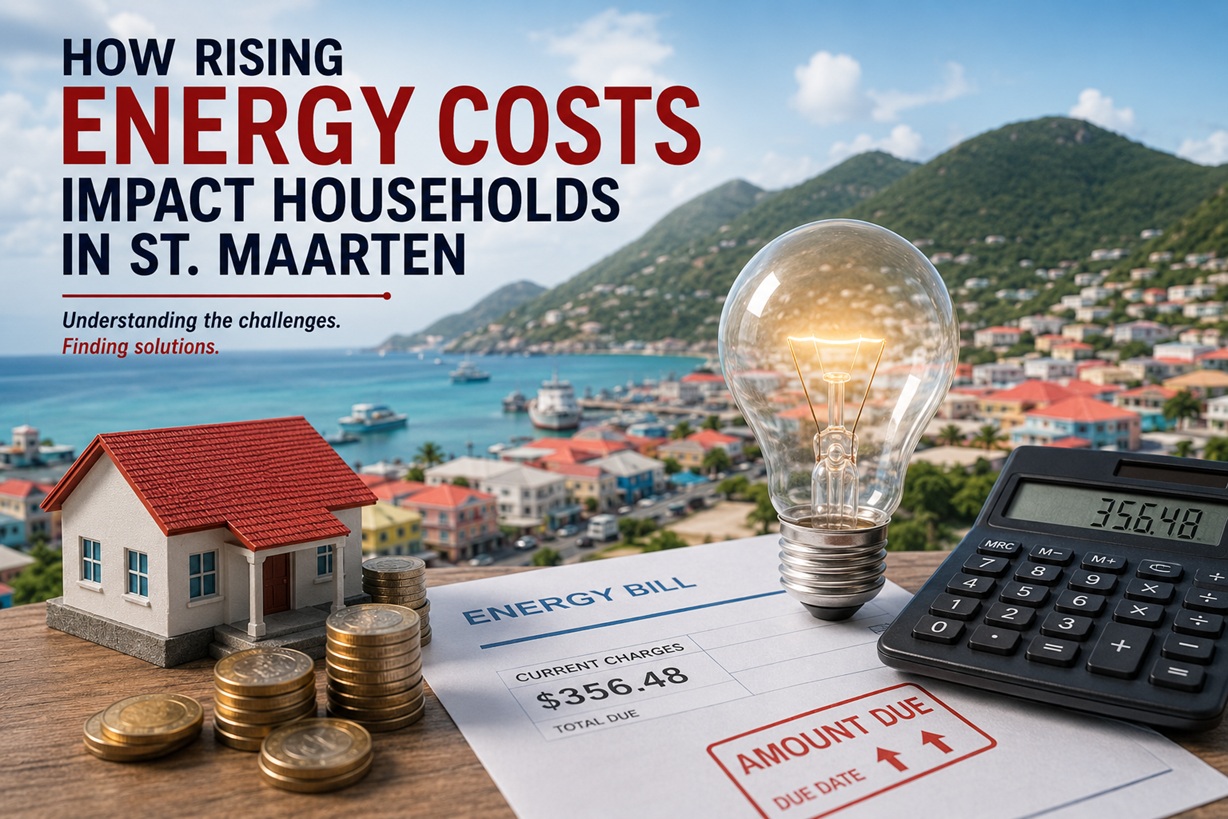
For many families in St. Maarten, energy costs are not a side issue. They shape how much money is left for groceries, transport, rent, school needs, and emergencies. That pressure is rooted in a long-standing structural problem: the island has long depended on imported fossil fuels, and both the government’s National Energy Policy and the World Bank continue to warn that this leaves the country exposed to volatile global prices, inflation, and sudden external shocks.
Understanding Rising Energy Costs in St. Maarten
St. Maarten’s energy vulnerability is not new. The government’s approved National Energy Policy, published in 2014, said the country was totally dependent on fossil fuels, warned that high electricity tariffs were a heavy burden on citizens and the wider economy, and linked rising oil prices to higher food costs, higher utility bills, weaker disposable income, and inflation. More recently, Minister Grisha Heyliger-Marten said the country “cannot continue to depend 100% on imported fuel,” while the World Bank noted that higher energy prices can raise import costs, reduce purchasing power, and dampen demand in an already import-dependent economy.
What has changed in 2026 is the speed of the latest swings. The Department of Statistics reported that headline consumer prices were still relatively stable in the first quarter of 2026, but it also made clear that its data collection largely missed the late-March fuel shock. In that same Q1 release, STAT said gasoline prices rose 6.8% and diesel prices 9.8% compared with the previous quarter. Official price regulations show how abrupt that shift was: the maximum retail gasoline price moved from XCG 2.074 per liter in December 2025 to XCG 2.288 in February 2026 and then to XCG 2.850 in March 2026; diesel moved from XCG 1.766 in December to XCG 1.918 in February and XCG 2.679 in March. Soon after, the Prime Minister said NV GEBE’s electricity fuel clause rose from XCG 0.36 per kWh in April 2026 to XCG 0.45 per kWh for May 2026.
That recent volatility came after a more mixed few years. The Centrale Bank van Curaçao en Sint Maarten said that lower international oil prices helped ease inflation in 2023, but it also noted that inflation in Sint Maarten accelerated in 2024, rising to 3.1% from 2.1% in 2023, with the increase driven in part by elevated domestic energy prices. The Bank added that, over the long run, inflation in Curaçao and Sint Maarten tends to move closely with global oil-price cycles because energy and transport costs feed directly and indirectly into the wider cost of living.
A government-commissioned 2025 tariff evaluation adds an important layer to this story: international oil prices are only part of the problem. The BTP SXM and RAC review found that between 2022 and 2024, the procurement prices GEBE paid SOL for light fuel oil and heavy fuel oil generally followed international market prices, but other tariff components increased over the same period. The same review found a clear operational shift in fuel use, with GEBE deliveries changing from roughly 95% HFO and 5% LFO in 2022 to 62% HFO and 38% LFO in 2024. That matters because LFO is generally more expensive per unit, even if it may have operational and maintenance advantages.
Impacts on Households
The pressure on households is amplified by the simple fact that utilities already take up an unusually large share of family budgets. In the official consumer basket, Housing, Water and Energy carries the largest weight at 36.1%, making it the single most influential category in overall inflation. A government social-security review, drawing on household expenditure and income data, found that average monthly household expenditure was ANG 6,860, of which ANG 2,566, or 37%, went to housing, water, electricity, gas and other fuels. That same review placed median household income at just ANG 2,000 to 3,000 per month, while also cautioning that the income and expenditure figures came from different studies and are therefore not directly comparable. Even with that caveat, the gap illustrates how little room many households have to absorb higher monthly bills.
The burden is even heavier for lower-income households. A government labor-market analysis found that in 2018, 5% of households had no income at all and 14% had household income of ANG 1,000 or less. The same report warned that Sint Maarten’s cost of living was among the highest in the Kingdom’s Caribbean territories. At the same time, the 2026 minimum hourly wage was set at XCG 10.93, a modest annual indexation rather than a dramatic jump in earnings. When energy costs spike faster than wages, that gap shows up immediately in arrears, delayed bill payments, and hard tradeoffs inside the home.
Energy costs also hit households indirectly. When gasoline and diesel rise, commuting costs go up, bus and taxi operators face higher input costs, and delivery prices can feed into groceries and other essentials. St. Maarten’s 2014 energy policy explicitly warned that rising fuel costs affect food products, energy bills, and disposable income, while STAT’s Q1 2026 release showed transport prices up year on year and vehicle fuel prices rising sharply in the quarter. In other words, higher energy costs are rarely confined to the utility bill alone.
This is one reason public frustration around tariffs has become so intense. The tariff evaluation concluded that, for years, effective regulation of the utility market was practically absent, leaving main operators in a position to determine tariffs unilaterally. The report said this lack of transparency contributed to diminished public trust. In May 2026, the government itself acknowledged that many households and businesses were under financial strain and that trust in GEBE was low. Rising energy costs are therefore not only a financial issue in St. Maarten, but also a governance and confidence issue.
Strategies for Managing Energy Expenses
Some household responses are practical and immediate. In a hot climate like St. Maarten’s, cooling costs usually do the biggest damage, so low-cost habits matter. ENERGY STAR recommends using blinds and shades to block direct sun during hot periods, while also checking cooling-system filters every month and changing them at least every three months because dirty filters force systems to work harder. The U.S. Department of Energy also notes that switching to LED lighting can sharply reduce electricity use, with residential LEDs using at least 75% less energy than incandescent bulbs, and that turning off inefficient lights when not in use saves both electricity and heat inside the home.
Water heating is another area where families can lower monthly consumption, especially in homes with electric water heaters. The Department of Energy says water heating typically represents a meaningful share of home energy use and recommends lowering the water-heater temperature to around 120°F where safe and practical. For households planning larger replacements, the same source says heat-pump water heaters can be two to three times more efficient than conventional electric resistance units, though the upfront cost is higher and the technology is more suitable for some homes than others.
For families already in distress, assistance now exists, though it is targeted rather than universal. The NV GEBE and Social Services Utility Relief Program began on December 1, 2025 and runs through November 30, 2026 as a one-year pilot. According to the government’s FAQ, eligible vulnerable residents can receive monthly vouchers worth XCG 50 each, up to XCG 250 per month depending on household size and income, and Social Services handles the intake and reassessment process. The government’s launch announcement describes the program as providing up to XCG 50,000 in monthly relief across existing and new vulnerable applicants.
Payment flexibility has also become part of the coping strategy. In 2023, government and GEBE discussed reducing the upfront deposit for repayment plans from 50% of the outstanding balance to 25%. In its May 2026 clarification on the fuel clause, GEBE also said that payment plans and senior relief programs remain available. For households facing immediate pressure, that means the most realistic short-term response is often a combination of lower consumption, payment restructuring, and applying for targeted relief, rather than waiting for broad tariff cuts.
Future Considerations and Policy Discussions
The policy debate is now centered on two linked questions: whether the tariff system is truly cost-reflective, and how quickly St. Maarten can reduce its exposure to imported fuel. The 2025 tariff evaluation was unusually blunt. It said the utility markets are monopolistic by nature, that the legal framework allows active regulation, but that in practice no effective regulation had been executed. It recommended regulation of fuel tariffs used for electricity generation, alongside independent oversight of electricity and water tariffs, preferably through BTP SXM.
Government has already started moving in that direction. In May 2026, it formally designated the Bureau of Telecommunications and Post as the independent supervisor of GEBE under the Electricity Concession Ordinance. According to the official release, BTP will be able to demand information, inspect operational and financial data, review tariff calculations, verify the fuel-clause methodology, and assess compliance with concession obligations. The same release stressed that government cannot simply set a tariff without verified cost data. That is significant because it marks the first serious attempt in years to move the debate from public outrage to structured regulatory oversight.
The tariff report also explains why households often feel that bills move in ways they cannot verify. It found that GEBE’s current electricity fuel-clause methodology uses realized fuel costs from month N-1 but applies the resulting rate to sales in month N, which makes structural monthly surpluses or deficits unavoidable unless there is a correction factor. Over the 2022 to 2024 period, the report estimated a cumulative surplus of about XCG 12.6 million, meaning revenues from the fuel clause exceeded actual fuel costs by that amount. It also concluded that electricity used to supply Seven Seas for water production should not be recovered through the electricity fuel clause paid by electricity consumers, and that the fixed 8.5% non-revenue electricity factor should be replaced by a dynamic monthly calculation.
Beyond tariff mechanics, longer-term reform is increasingly focused on the energy mix itself. The government-commissioned review recommended a regulatory evaluation of the SOL-GEBE fuel relationship, an optimization plan for the use of different fuels, and an Integrated Resource Plan that aligns long-term electricity development with the National Energy Policy and a transition to more renewable energy. That recommendation echoes the 2014 energy policy, which called for moving away from diesel and heavy fuel oil, improving efficiency at GEBE, and expanding renewable options.
There are early signs of that shift, though they are still at the planning and resilience stage rather than visible on household bills. In 2024, NV GEBE partnered with Energynautics GmbH, with support from the Sint Maarten Trust Fund, to prepare a least-cost power development plan focused on reliability, system upgrades, and integration of renewable energy for what was described as GEBE’s inaugural renewable project. Parallel resilience works, including underground utility infrastructure in several districts, are aimed at making the grid more disaster-resistant. These projects will not provide instant tariff relief, but they matter because a more efficient and more resilient system is the only credible route to lower volatility over time.
Open Questions and Limitations
Important pieces of the pricing story are still not fully public. The 2025 tariff evaluation noted that GEBE did not provide all requested annual accounts and that the current electricity base rate of XCG 0.25, unchanged since 2011, could not be validated on the data available to the evaluators. The report also said the current formula for determining electricity tariffs could not be fully validated and that even one checked billing period showed a difference between the calculated and actual fuel clause invoiced to customers. That means the public still does not have a complete, independently verified picture of the true cost structure behind every component of the bill.
The Bottom Line
Rising energy costs in St. Maarten are not just the result of bad luck in global oil markets. They are the product of three forces acting together: deep dependence on imported fuel, a tariff system that has lacked strong independent oversight, and household budgets that already devote a very large share of spending to housing and utilities. The short-term answer for families is a mix of conservation, payment flexibility, and targeted relief. The long-term answer is more difficult but clearer: independent regulation, transparent tariff setting, better fuel procurement governance, and a genuine shift toward a more efficient and more renewable energy system. Until those structural changes take hold, St. Maarten households will remain exposed every time global fuel prices jump.
###
ADVERTISEMENT