Advertisement





By Terrance Rey
A question posed recently by a policy advisor on St. Maarten stopped me in my tracks:
“Can a society remain stable when ownership increasingly depends on already having wealth?”
It is a deceptively simple question.
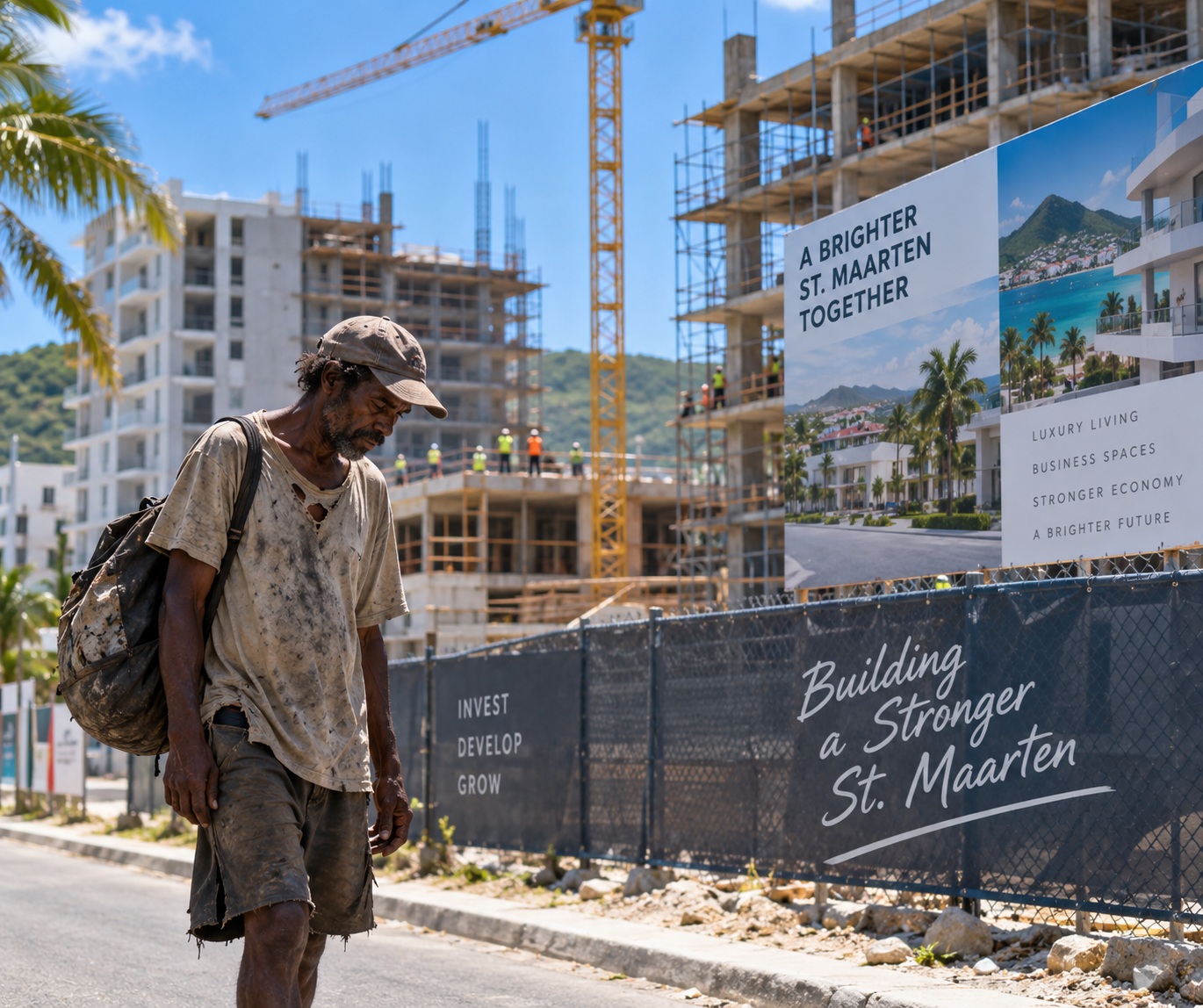
The discussion that followed centered largely on housing, land prices, foreign investment, wages and the increasing difficulty young St. Maarteners face trying to purchase a home.
One participant summarized the concern this way: wealth may be entering St. Maarten, but ownership is becoming increasingly difficult for the people who actually live and work here.
Another raised an equally legitimate question: if you already own land, why should you be expected to sell it below the price someone is willing to pay?
That question matters.
Because I do not believe the solution to St. Maarten’s ownership problem is telling existing property owners that they should accept less for their assets.
Nor do I believe our answer should simply be to complain about foreign investors.
My conclusion is different.
St. Maarteners need to become investors.
And increasingly, we need to learn how to invest together.
We Need an Investment Mindset
For generations we have been taught a relatively straightforward economic formula:
Go to school.
Get a good education.
Find a good job.
Earn a salary.
Save some money.
Buy a house.
Retire.
There is nothing inherently wrong with that formula.
The problem is that in a modern asset based economy, income alone is increasingly competing against capital.
A person earning a salary and trying to save $500 or $1,000 every month may eventually find himself bidding for the same property against an investor, company or investment group that already owns several income producing assets and has access to substantial financing.
That is a completely different game.
And complaining about the game will not change it.
We have to learn how to play it.
Stop Thinking Only as Individuals
One of our biggest weaknesses on St. Maarten may be our insistence on trying to do everything individually.
One person may not have $1 million to purchase an apartment building.
But what about twenty people with $50,000 each?
One young professional may not have enough capital to acquire commercial property.
But what happens when ten, twenty or fifty professionals establish a properly structured investment company and begin contributing capital every month?
What happens when local entrepreneurs, professionals, tradespeople and members of the diaspora begin pooling capital into properly governed investment vehicles?
Suddenly we are no longer talking about people who cannot afford to participate.
We are talking about capital.
And capital has purchasing power.
This does not mean casually handing money to friends or relatives. Collective investment requires professional management, audited accounts, legal agreements, defined shareholder rights, transparency, proper governance and clear rules for entering and exiting an investment.
But we need to start thinking this way.
The First Asset Is the Hardest
Imagine a group of St. Maarteners pooling their resources and purchasing an income producing property.
The objective should not simply be to own the property.
The objective should be to own an asset that produces positive cash flow.
The rental income pays the operating expenses.
It services financing.
It builds reserves.
It produces equity.
And over time, that equity becomes the foundation for acquiring the next asset.
That is where something important happens.
The group no longer approaches a financial institution merely saying:
“We have an idea.”
They can say:
“We own this asset. It generates this amount of revenue. Here are the financial statements. Here is our equity. Here is our cash flow. And here is the next investment we want to make.”
That is an entirely different conversation with a bank.
The same principle applies beyond real estate.
It could be a tourism business.
A commercial building.
Warehousing.
Renewable energy.
Transportation.
Technology.
Hospitality.
A small hotel.
A marina related business.
An apartment complex.
Or an established local company whose owner wants to retire and sell.
The principle remains the same:
Pool capital. Acquire productive assets. Generate cash flow. Build equity. Reinvest. Leverage responsibly. Repeat.
That is how wealth compounds.
We Cannot Sell the Same Piece of Land Twice
There was another important point made during the original discussion.
St. Maarten is small.
Land is finite.
Once a family sells a piece of land, spends the proceeds and consumes the money, the transaction may be over forever.
One contributor therefore suggested that landowners consider alternatives such as long term ground leases rather than automatically selling family land. The idea is straightforward: retain ownership of the underlying land while allowing somebody else’s capital to develop it and generate income from it.
That will not work in every situation.
But the underlying thinking is exactly what we need more of.
Stop looking only at the sale price of an asset.
Start looking at its income producing potential over generations.
There is a fundamental difference between having money and owning an asset.
Money gets spent.
Productive assets can keep paying you.
Government Has a Role, But Government Cannot Build Your Wealth
Government clearly has responsibilities in housing, spatial planning, infrastructure and creating conditions in which residents can participate in the economy.
In fact, Government’s Housing Policy 2025–2035 identifies high housing costs relative to average incomes, limited available land, population growth and short term rental investment among the challenges confronting the housing market. The policy targets at least 1,200 new dwellings over ten years and includes plans to reactivate the Mortgage Guarantee Fund to assist first time homebuyers.
Those are important initiatives.
Government has also acquired approximately 288,402 square meters of land at Belvedere, with part intended for mixed housing development.
But there is something Government cannot legislate into existence:
an investment culture.
Government cannot force us to save.
Government cannot force us to invest.
Government cannot force five friends to stop talking about becoming wealthy and actually incorporate a company, contribute capital and purchase their first asset.
Government cannot force successful St. Maarteners abroad to invest some of their accumulated capital back home.
Government can help create the environment.
We have to build the capital.
The Silent Brain Drain May Be More Dangerous
Perhaps the most troubling part of the original discussion was not about property at all.
It was about young people.
One participant described young professionals quietly building assets elsewhere because they no longer see a viable financial future on St. Maarten.
That should concern us.
Brain drain does not always announce itself.
There does not have to be a protest.
There does not have to be a demonstration in front of the Government Administration Building.
Sometimes a talented young St. Maartener simply finishes university in the Netherlands, the United States, Canada or elsewhere and decides:
“I can build a better life here.”
Another buys a house abroad.
Another starts a company abroad.
Another begins investing abroad.
Another raises a family abroad.
Twenty years later we suddenly ask:
Where did everybody go?
But they did not leave suddenly.
They left one decision at a time.
The original discussion made precisely this point: when people move their savings, ambitions and eventually their families elsewhere, individual decisions can gradually become a national direction that is extremely difficult to reverse.
What Happens If We Do Nothing?
My concern is not foreign investment itself.
St. Maarten needs outside investment.
We need outside capital, expertise, visitors, entrepreneurs and businesses. We have built much of our economy by being open to the world, and that openness remains one of our strengths.
The danger arises when outside capital is investing while local capital is primarily consuming.
If one group consistently acquires productive assets while another group primarily earns wages and consumes, ownership will gradually concentrate with the group acquiring the assets.
There does not have to be a conspiracy.
There does not have to be some grand plan to “take over St. Maarten.”
It can happen through simple economics.
Those who continually buy assets eventually own the assets.
And those who own the productive assets increasingly receive the rents, dividends, interest, appreciation and business profits those assets generate.
That income gives them the capital to purchase still more assets.
That is the compounding effect of ownership.
Buying Back Our Island
When I say St. Maarteners need to start buying back their island, I am not talking about excluding anyone.
I am talking about participating.
I am talking about ownership.
I am talking about building local capital strong enough to compete for assets in our own economy.
Imagine investment clubs consisting of ten young professionals.
Imagine professionally managed local property investment companies with hundreds of St. Maarten shareholders.
Imagine families placing inherited land into family holding companies instead of dividing and selling it.
Imagine successful St. Maarteners living abroad being able to invest in credible, transparent local investment funds.
Imagine local pension capital, private investors, entrepreneurs and financial institutions participating in well structured developments.
Imagine young people being taught not merely how to get a job, but how shares, bonds, mortgages, equity, cash flow, compound returns and business ownership actually work.
Imagine teaching a generation that the objective is not merely:
“I want a good salary.”
But:
“I want to own productive assets.”
That is a very different economic mindset.
Start With $100 If Necessary
Not everybody has $50,000.
That cannot become an excuse for doing nothing.
Investment culture starts with behavior.
Someone who learns to invest $100 consistently is developing a fundamentally different relationship with money from someone who believes every dollar earned must eventually become consumption.
The first objective is not becoming a millionaire.
The first objective is becoming an owner.
Own something.
Then own more.
And wherever practical, own it together.
Because our greatest untapped financial resource may not be Government.
It may not be another foreign investor.
It may be each other.
There are tens of thousands of people connected to this island. Individually, many may lack the financial capacity to acquire major assets.
Collectively, the equation changes dramatically.
The Choice Before Us
St. Maarten will continue developing.
Properties will be bought.
Businesses will be established.
Hotels will change hands.
Commercial buildings will be constructed.
Land will appreciate.
New industries will emerge.
Capital will continue looking for opportunities.
The question is not whether those things will happen.
The question is:
How much of it will we own?
If St. Maarteners remain primarily employees and consumers while others become the shareholders, landlords, developers, financiers and business owners, we should not be surprised by what the island looks like twenty or thirty years from now.
We could eventually find ourselves living on an economically successful island on which increasingly little of the productive economy belongs to the people who call it home.
That is the future we should be discussing now.
Not because we should fear outsiders.
But because we should finally understand ownership.
The answer is not resentment.
The answer is not isolation.
The answer is not waiting for Government to save us.
The answer is organization, financial education, cooperation, investment and ownership.
Pool our resources.
Buy productive assets.
Build cash flow.
Build equity.
Use that equity intelligently.
Reinvest.
And teach the next generation to do the same.
Because if we want future generations of St. Maarteners to have a meaningful stake in this island, then we have to start building that stake today.
St. Maarten does not simply need more local income.
St. Maarten needs more local owners.
If you agree – or disagree – join the discussion online at:
https://www.facebook.com/share/p/1FL57gtLHv/
###
Related articles:
Investment Promotion Begins at Home
Curaçao Is Showing Us the Way. Will Sint Maarten Follow?
Beyond Start Smart: Give Local Startups a Three-Year Startup Growth Period
Blockchain Technology Proposed as Long‑Term Solution to TEATT Licensing Issues
###
ADVERTISEMENT