Advertisement





By Hilbert Haar
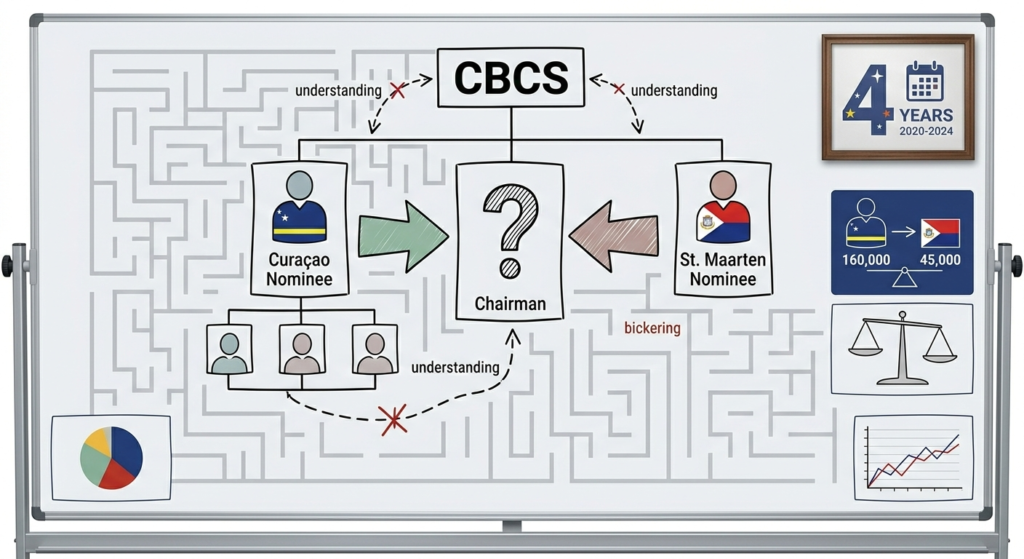
Putting Curacao and St. Maarten together in a monetary union was never the brightest of ideas. The politicians of these two autonomous countries have proven that they are unable to work together in a sensible way. Therefore, it cannot surprise anyone that the CBCS supervisory board has been without an appointed chairman for four years.
There is of course a lot of bickering about which country should nominate and appoint a candidate for that position. This is an unavoidable dispute because the law that rules the central bank does not contain any provision to settle this matter.
The law is clear, Finance Minister Marinka Gumbs has stated in a press release: “The nomination rests with the ministers of finance of both countries and not indefinitely with the supervisory board.”
That raises of course the question: if the law is so clear, then why has no chairman been appointed?
I think that the reason for this deadlock is to be found in the inequality between Curacao and St. Maarten. Curacao has something like 160,000 inhabitants and St. Maarten’s population hovers around the 45,000. So Curacao is more or less 3.5 times bigger than St. Maarten. Big deal? In Curacao they certainly think so and based on the numbers they even may have a point.
The thing is of course that the two countries – unequal or not – also have common interests, otherwise they would not even be together in a monetary union.
The CBCS keeps a keen eye on the economy in the union and it provides thorough research that both countries could use to their benefit. So why don’t they?
Well …. It is an old story but it will do no harm to repeat it a bit here. Politicians in Willemstad and in Philipsburg have their own agenda –and those agendas are not necessarily the same. Finding common ground is complicated – to put it politely – and Curacao is in a position to strong-arm its little brother in Philipsburg.
Currently, the dispute is about which country is allowed to nominate a chairman for the supervisory board. Traditionally, that position rotated between the two countries. Nothing legally binding, just a friendly political understanding.
Apparently, there is no understanding anymore and that is why the CBCS remains without a chairman of its supervisory board for the foreseeable future unless the politicians who are in a position to make something happen – after four years! – come to their senses.
Good luck with that.
###
ADVERTISEMENT