Advertisement





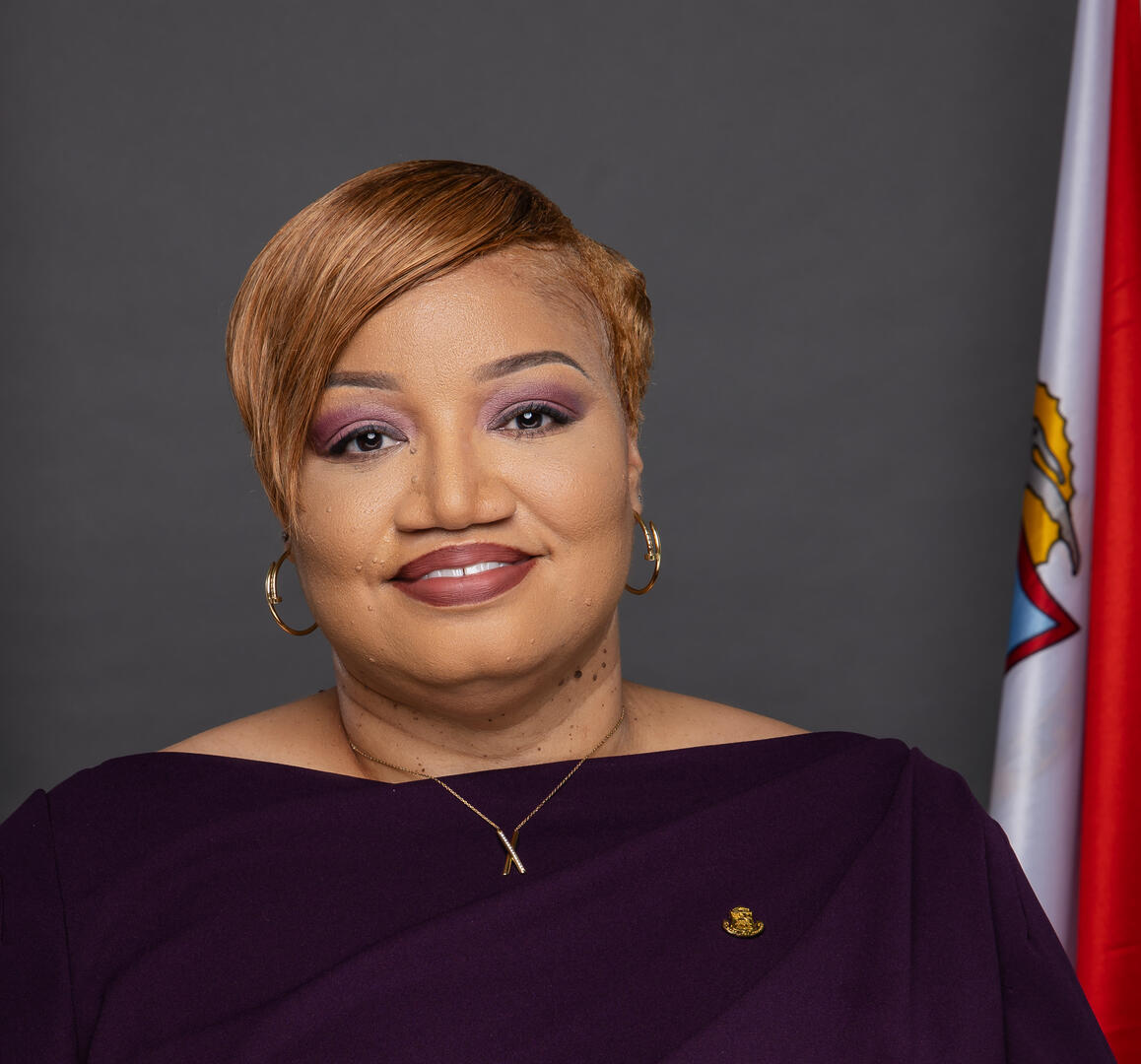
PHILIPSBURG — Finance Minister Marinka Gumbs on Tuesday delivered a frank assessment of the state of the monetary union with Curaçao, telling Parliament that the Central Bank of Curaçao and St. Maarten (CBCS) has not consistently functioned as an equal partnership.
Speaking during a Central Committee meeting on the future of the monetary union, Gumbs said the Central Bank’s performance over the past 15 years has been “mixed,” pointing to structural imbalances that, in her view, have disadvantaged Sint Maarten.
“In theory, it was to serve both countries independently and impartially with balanced representation and shared consensus decision-making,” Gumbs said of the CBCS. “In practice, however, the experience of the past 15 years has shown that the structure and operations have not always reflected this ideal.”
The minister repeatedly emphasized that governance has been a central issue. While the Central Bank’s statute provides for equal representation, she said the reality has often been different. “From the onset, the Supervisory Board of Directors has been dominated by Curaçao,” Gumbs stated. “Although the statute calls for equal representation, the political reality has been that Curaçao has had a more significant influence and control.”
According to Gumbs, this imbalance has had concrete consequences, affecting appointment processes, strategic decision-making, and the extent to which St. Maarten’s concerns are addressed within the institution.
She also pointed to what she described as supervisory failures, singling out the ENNIA insurance crisis as a major example. “Warning signs were present for years, yet decisive action came only after the situation had deteriorated significantly,” she told Parliament. “For St. Maarten, the consequences have been severe. Thousands of our people have seen their pensions and life savings placed at risk.”
Gumbs further criticized the bank’s communication practices, saying that St. Maarten authorities have not always been kept adequately informed, particularly during critical moments. “Key information has not always been shared in a timely or comprehensive manner,” she said, adding that this has contributed to a perception that the CBCS does not function as a truly equal binational institution.
The minister also highlighted differences between the two economies, arguing that policy decisions have not always reflected Sint Maarten’s realities. “Curaçao’s economy is more industrial, more diversified,” she said. “St. Maarten’s is tourism-driven. Yet monetary and supervisory policies have not always reflected these differences.”
Another recurring concern raised by Gumbs was the centralization of operations in Curaçao. Despite being a joint institution, she said, the bank remains heavily Curaçao-centric in its staffing, infrastructure, and decision-making culture. “This has created greater access to information, greater institutional influence, and greater employment benefits for Curaçao,” she noted.
Summing up her position, Gumbs made a direct and pointed statement: “In my own assessment, Curaçao has benefited more from the CBCS than St. Maarten.” She attributed this to Curaçao’s larger financial sector, its stronger influence over policy direction, and the fact that the bank’s headquarters and most of its operations are based there.
The minister linked these longstanding issues to the current tensions within the monetary union, particularly as Sint Maarten has become more assertive in demanding that the principle of equality be upheld. “That imbalance was tolerated for some time,” Gumbs said. “But once St. Maarten began to demand equality as envisaged in the statute, the divisions became more glaring.”
Her remarks come amid indications that Curaçao is considering withdrawing from the monetary union. Gumbs said such a move would be driven by factors including a desire for full monetary control, fiscal pressures, and divergent economic paths.
“Curaçao has expressed a desire to control its own monetary policy, set its own interest rates and manage its own currency,” she said.
However, she cautioned that dismantling the union would be a complex and far-reaching process. “You can’t just walk away from a joint central bank, and certainly not after 15 years,” Gumbs said. “If the union ends, we must negotiate who takes which assets, who assumes which risks and obligations, and how to protect people’s deposits, contracts and confidence.”
She explained that the process would involve dividing foreign exchange reserves, financial assets, and liabilities, while also determining future monetary arrangements.
To prepare for all scenarios, Gumbs announced that Government will establish a task force on monetary future and financial stability. “We are not waiting for events to overtake us,” she said. “We are taking decisive action.”
The task force will evaluate the current monetary union, assess the implications of a possible dissolution, and examine options such as introducing a national currency, adopting a foreign currency, or entering a new monetary arrangement.
Gumbs stressed that financial stability will remain the government’s top priority. “Any dismantling must never jeopardize the financial stability of our nation,” she said. “We will not compromise the interests of our people.”
She also made clear that St. Maarten will insist on being treated as an equal partner moving forward. “We will not accept any subordinate role in this unfolding situation,” Gumbs told Parliament.
Despite the uncertainty, the minister expressed confidence that the country can navigate the challenges ahead, pointing to its resilience in the face of past crises. “This moment requires unity, resolve and clarity of purpose,” she said. “We will be ready for any and all outcomes.”
###
Related articles:
Effectiveness of monetary union is important, says Wescot-Williams
Curacao wants to get out of monetary union
MPs Call for Urgent Parliamentary Meeting on Future of Monetary Union with Curaçao
Exclusive: Wescot-Williams Says CBCS Governance Dispute Sparked Call for Parliamentary Discussion on Monetary Union
ANALYSIS: What Happens if the Monetary Union Between Curaçao and Sint Maarten Ends?
Prime Minister addresses monetary union tensions amid CBCS governance dispute
Archived news articles about ‘monetary union’>>>
###
ADVERTISEMENT