Advertisement





By Hilbert Haar
The democratic revolution began in 1989 in Porto Allegre, a city with 1.4 million inhabitants in the Brazilian state of Rio Grande do Sul. The city’s dramatic change of direction was copied shortly by more than one hundred Brazilian cities.
Let’s take the example of Torres, a municipality in the same state as Porto Allegre, where elections were held on October 31, 2004.
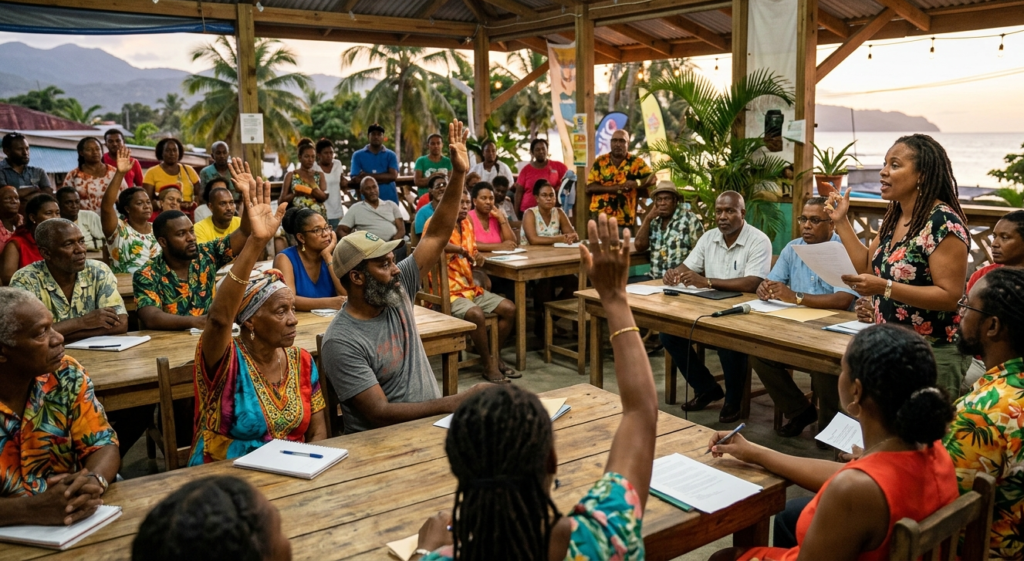
The obvious frontrunners were Javier Oropeza, a wealthy landowner and Walter Cattivelli. Both candidates had powerful backers so the outsider in the race, Julio Chávez was not taken seriously. Chávez wrote a short and simple manifesto: if the people elected him as the new mayor he promised to hand over power to his citizens. Against all odds, Chávez narrowly won the elections and what’s more: he kept his word. Time for St. Maarten to pay attention to what the new mayor did: he gave his citizens the right to decide how to spend the budget available for investments.
The effects of what is now called participatory budgeting were astounding. The Dutch historian Rutger Bregman writes in his book Humankind that corruption and clientelism went way down and that the population’s participation in politics increased significantly. Torres saw the unprecedented construction of new houses and roads and districts that were neglected under the previous regime got a nice makeover.
No wonder that it did not take long for hundreds of other Brazilian cities to adopt the principle of participatory budgeting. Porto Allegre lit the fire, being the first to introduce this system. Bregman points out that the city has one of the largest participatory budgets in the world. It is an understatement to say that this way of sending public money is appealing. According to Bregman, by 2016 more than 1,500 cities across the world had implemented some form of participatory budgeting.
“Citizen politicians engage in calm and deliberate dialogue,” Bregman wrote. “This may sound dull but it is magic. It might just be the remedy for the seven plagues afflicting our tired old democracies.”
If this all sounds utterly boring, ask yourself how satisfied you are with the things politicians in St. Maarten are doing. Infighting and mudslinging seem to take up most of their time, while there is no, or hardly any, attention for the real problems that affect the everyday life of our citizens.
Bregman labels the system as one of the biggest movements of the twenty-first century, and the answer to the increasing divide between citizens and the political establishment. Community groups of engaged citizens grew from 160 in 1989 to 600 in the year 2000. And these citizens began to address each other as compatriots and brothers.
These community groups revealed something else: democracy was no longer the playground of well-off white men and women. Minorities and poorer and less-educated segments of society were far better represented.
Bregman concludes that democracy as practiced in Torres and Porto Allegre is “a training ground for citizenship.”
So how could participatory budgeting work in S. Maarten? The sad thing is that it would firstly require a political decision and we cannot expect the current political establishment to give up their cozy and overpaid jobs without a fight.
However, as the victory of an underdog like Julio Chávez in Torres shows, the people are in control of what will or will not happen. So what if during the next elections, somebody comes out of nowhere with the promise to hand over the country’s investment budget to those same people? Will that bring about the change in our political culture that St. Maarten so desperately needs? It is at least something to think about.
###
ADVERTISEMENT