Advertisement





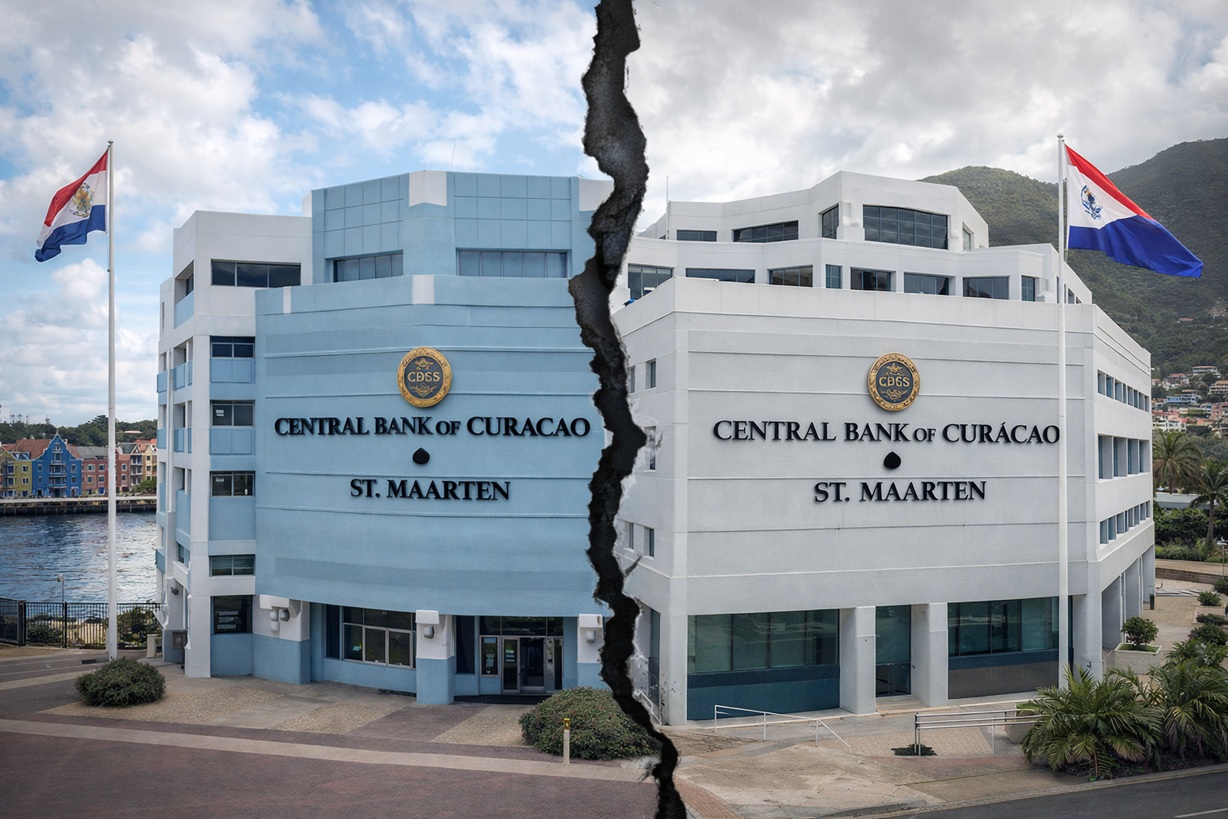
PHILIPSBURG — The ongoing dispute surrounding governance at the Central Bank of Curaçao and Sint Maarten (CBCS) has unexpectedly reopened a fundamental question:
What would happen if the monetary union between Curaçao and Sint Maarten were to end?
While no such decision has been made and both countries continue to operate within the existing framework, the debate has prompted policymakers and observers to consider the possible scenarios should the current arrangement eventually change.
Understanding the implications requires first examining what the monetary union is, why it was created, and how it functions today.
What Is the Monetary Union?
When the Netherlands Antilles was dissolved in October 2010, Curaçao and Sint Maarten agreed to maintain a shared monetary system.
Both countries would:
- share one central bank — the CBCS
- use a common currency
- coordinate monetary policy
For decades the shared currency was the Netherlands Antillean guilder.
On March 31, 2025, the two countries officially introduced the Caribbean guilder (XCG) as the new currency of the monetary union.
The transition took place smoothly and without major disruption.
What Does the CBCS Do?
The Central Bank of Curaçao and Sint Maarten plays a critical role in the financial stability of both countries.
Its responsibilities include:
- issuing the Caribbean guilder
- supervising commercial banks
- regulating financial institutions
- maintaining foreign reserves
- protecting financial stability
In short, the CBCS functions as the guardian of the financial system for both countries.
Because of this role, governance disputes at the Bank quickly become politically sensitive.
What If the Monetary Union Collapses?
If the monetary union were to dissolve, both countries would need to determine how their monetary systems would function independently.
Several possible options exist for Sint Maarten.
Option 1
Sint Maarten Creates Its Own Central Bank
One theoretical option would be for Sint Maarten to establish its own independent central bank and manage its own currency.
However, many economists consider this option costly and complex for a small island economy.
Operating a central bank requires:
- significant foreign reserves
- financial regulatory infrastructure
- experienced monetary policy experts
- international credibility
For a small economy like Sint Maarten, maintaining such an institution independently could prove expensive.
Some experts suggest that if Sint Maarten were to pursue this route, it would still likely need a service level agreement with another central bank to provide oversight and technical support.
Option 2
Adopting the US Dollar
Another possibility would be to adopt the United States dollar.
This approach already exists within the Kingdom of the Netherlands.
The Dutch Caribbean islands of Bonaire, St. Eustatius and Saba (the BES islands) use the US dollar as their official currency.
Adopting the dollar could simplify trade with the United States, which remains Sint Maarten’s largest trading partner.
In such a scenario, financial supervision could potentially be coordinated through agreements involving the Dutch Central Bank (DNB).
However, dollarization would also mean giving up the ability to influence monetary policy.
Option 3
Joining a Caribbean Monetary Union
Sint Maarten could also explore joining a regional monetary arrangement such as the Eastern Caribbean Currency Union, which is governed by the Eastern Caribbean Central Bank (ECCB).
Several Caribbean countries, including St. Lucia, Antigua, Dominica and Grenada, already share the Eastern Caribbean dollar under this system.
Joining such a union would require significant negotiations and economic alignment but could provide an existing institutional framework.
Option 4
Adopting the Euro
Another theoretical option would be the adoption of the Euro, potentially through arrangements involving the Netherlands.
This idea occasionally arises because the French side of the island, Saint-Martin, already uses the Euro as part of France and the European Union.
A shared currency across the island could simplify cross-border commerce and tourism.
However, such a transition would involve complex legal and financial agreements and would require coordination with European institutions.
A Digital Economy Dimension
The debate about monetary systems is also tied to the future of financial technology.
Many residents and businesses on Sint Maarten continue to face challenges accessing global digital payment platforms such as:
- PayPal
- Stripe
- Wise
- Revolut
- and many other fintech solutions, including crypto-currencies.
Improving access to these platforms could significantly benefit local entrepreneurs, freelancers and online businesses.
As global commerce increasingly moves toward digital transactions, financial infrastructure and regulatory alignment will become even more important.
A Complex Question With No Immediate Answer
For now, the monetary union remains intact and the Caribbean guilder continues to function as the shared currency of both countries.
But the current governance dispute at the CBCS has demonstrated how institutional tensions can quickly raise broader questions about the future of the arrangement.
Whether the union continues or eventually evolves, one thing is clear:
The decisions made in the coming years could shape Sint Maarten’s financial future for decades to come.
Next Coverage
StMaartenNews.com will continue to follow this issue closely and bring readers further analysis and expert perspectives as the debate develops.
###
Related articles:
Exclusive: Wescot-Williams Says CBCS Governance Dispute Sparked Call for Parliamentary Discussion on Monetary Union
MPs Call for Urgent Parliamentary Meeting on Future of Monetary Union with Curaçao
###
ADVERTISEMENT