Advertisement





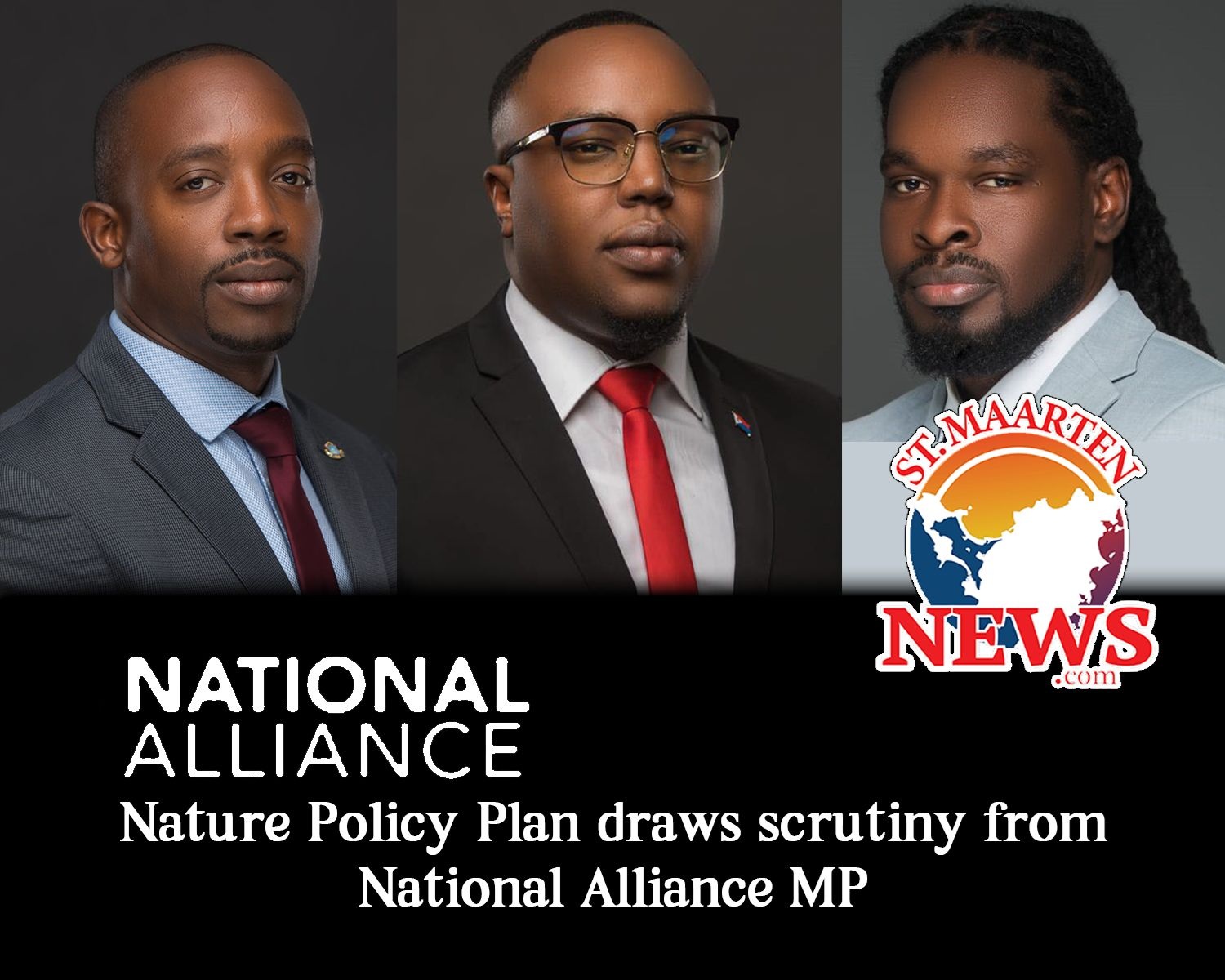
PHILIPSBURG — Members of Parliament from the National Alliance (NA) have raised serious concerns over the government’s updated Nature Policy Plan 2025–2030, questioning whether the plan can deliver on its promises or if it risks remaining a paper exercise. During a parliamentary review session this week, the MPs highlighted gaps in transparency, enforcement, and operational readiness.
An elaborate list of questions from NA Member of Parliaments Egbert Doran and Darryl York underscored long-standing frustrations with Minister of Public Housing, Spatial Planning, Environment and Infrastructure VROMI Patrice Gumbs’ management of environmental and development matters.
The minister, representing the Party for Progress (PFP), presented the plan as a comprehensive framework aimed at balancing conservation, sustainable land use, and climate adaptation. It includes nine policy objectives targeting biodiversity protection, ecosystem conservation, climate resilience, enforcement, and coordination among agencies.
Minister Gumbs also noted that the National Biodiversity Finance Plan (NBFP), prepared with Grant Thornton, is expected to have a first draft by the second quarter of the year, though he admitted significant work remains to finalize the plan.
While the minister framed the presentation as ambitious and forward-looking, MPs from the National Alliance pressed on practical implementation and accountability. MP Doran questioned what principles had actually changed from the previous policy, noting that, in his view, the current plan appeared largely a rehash of prior initiatives. He demanded clarification on which environmental factors are prioritized when reviewing permit applications, how cumulative development impacts are considered, and how limited land availability is managed in districts with varying development pressures.
Doran also raised concerns about civil works permits, highlighting reports of inconsistent application and alleged favoritism. He asked the minister to provide a month-by-month breakdown of applications and approvals, reflecting public complaints that some developers appear to receive preferential treatment while others are scrutinized more heavily. He challenged whether current procedures meet the standard of fair, transparent governance, particularly in hillside and sensitive areas vulnerable to erosion.
MP York expanded on these concerns, citing numerous unanswered letters and meeting requests submitted to the ministry over the past year. York insisted that the minister’s earlier claim that only one meeting request had gone unanswered was misleading, listing more than a dozen documented communications that had not received formal responses. He questioned whether the ministry was systematically ignoring parliamentary oversight and noted that delays in addressing these requests undermined public confidence in government processes.
York further pressed Minister Gumbs on the practical outcomes of the plan. He asked how it would tangibly change permit approvals, reduce flooding or erosion, or enforce protections against illegal dumping and mangrove destruction. He emphasized the importance of clear targets, such as the 30% restoration and protection goals, and demanded clarification on consequences if these targets are missed. York also questioned whether the plan’s emphasis on international obligations, such as Convention on Biological Diversity (CBD) reporting, overshadowed concrete domestic actions to address ongoing environmental challenges.
Revenue and financing also emerged as key points of contention. Nation, Opportunity and Wealth (NOW) MP Lyndon Lewis questioned the plan’s lack of concrete revenue-generating mechanisms, suggesting measures such as environmental transit taxes on tourists, similar to systems in neighboring islands, which could fund conservation initiatives without burdening residents. He also noted that economic impact assessments for development projects remain largely optional, raising doubts about whether decisions will be made with sufficient consideration of environmental and financial trade-offs.
A recurring theme from the National Alliance MPs was enforcement and operational capacity. MPs emphasized that the Nature Foundation and other advisory bodies provide guidance but cannot implement policy themselves. They questioned whether the ministry has sufficient inspectors, budget allocations, and procedures to enforce regulations effectively. Concerns were raised over invasive species management, climate adaptation measures, and the protection of newly acquired government land, such as Belvédère South, noting that operational costs for maintaining conservation areas had not been clearly budgeted for 2026.
MPs also pressed for clarity on zoning and land acquisition, highlighting discrepancies between the government’s stated plans and existing land use. York, Doran, and Lewis questioned whether private landowners would be compensated if zoning restrictions limit development, and whether appraisal reports were conducted for recent purchases. They emphasized that without clear mechanisms for land acquisition and enforcement, the policy risks creating disputes and legal challenges rather than effective protection.
The NA MPs criticized the plan for being technically complex and inaccessible to the public. They warned that residents would struggle to understand how policies translate into tangible protections or benefits. York and Lewis both stressed the need for transparency, clear communication, and public engagement, arguing that without these elements, the plan could be dismissed as a bureaucratic exercise rather than a meaningful tool for sustainable development.
In response, Minister Gumbs defended the plan as a foundation for evidence-based decision-making, noting that many outputs, such as the Climate Impact Atlas and updated civil works manuals, are designed to integrate biodiversity and climate adaptation into planning. He emphasized that once approved, the plan would meet international reporting obligations and guide the development of operational procedures. However, MPs remained unconvinced, noting that policy documents alone do not guarantee implementation without adequate resources, clear responsibilities, and oversight mechanisms.
The session also raised concerns about timelines and deliverables. MPs noted that previous commitments, including the 2021–2025 zoning plans and conservation initiatives, were delayed or not fully executed. Doran and York emphasized that similar delays with the 2025–2030 plan could further erode public trust, particularly if promised green zones, civil works compliance, and invasive species control are not implemented in a timely manner.
Minister Gumbs indicated that a follow-up session to respond to MPs’ questions is tentatively scheduled for February 9, signaling the need for more detailed explanations and assurances regarding operationalization, enforcement, and budgetary support.
MPs insisted that this session must provide concrete answers, not general statements, to restore confidence in the ministry’s ability to implement the plan effectively.
###
ADVERTISEMENT