Advertisement





From our news correspondent
PHILIPSBURG — During Parliament’s question hour on December 15, Prime Minister Dr. Luc Mercelina confirmed that utilities company NV GEBE has requested government-owned land to develop its first solar energy project. In response to questions from Parliament, the Prime Minister stated that approximately 5,000 square meters of land are required to generate one megawatt (MW) of solar power.
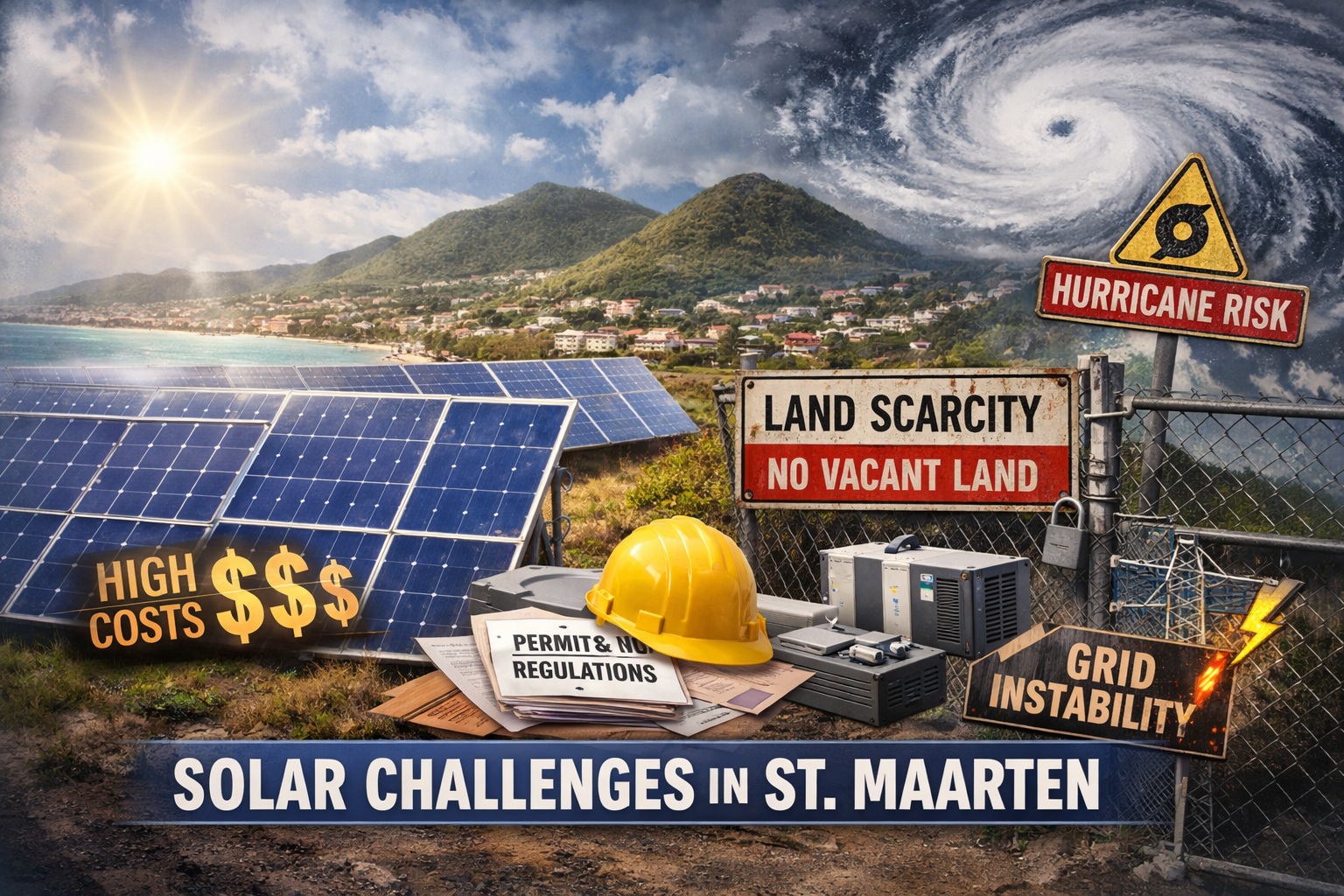
While the announcement points to growing interest in renewable energy, multiple structural, financial, and environmental factors raise serious questions about whether large-scale solar development on government land is feasible under current conditions on St. Maarten.
One of the most immediate challenges is land scarcity. St. Maarten is already densely developed, with very limited unused government land available. Public land is in high demand for housing, social facilities, and institutional use, and many residents and organizations have been waiting years for allocations. Assigning large tracts of land to solar production would intensify competition for an already scarce resource and could limit other critical development opportunities.
Hurricane vulnerability represents another major obstacle. Situated in a hurricane-prone region, St. Maarten is exposed to the risk of extreme winds and flying debris. Standard solar installations are unlikely to withstand Category 4 or 5 hurricanes without specially engineered, reinforced mounting systems. These adaptations significantly increase construction costs, while insurance coverage for solar farms in hurricane zones is either prohibitively expensive or difficult to secure.
High insurance premiums and maintenance costs further complicate the economic case. In the Caribbean, insuring solar infrastructure against storm damage costs far more than in temperate regions. Following severe weather events, damaged panels must be replaced, and systems recalibrated, creating ongoing expenses that can quickly erode projected savings.
Upfront investment costs are also substantial, with a long and uncertain return on investment. Tropical conditions accelerate the degradation of solar panels due to intense ultraviolet radiation, salt-laden air, and high humidity. When combined with the need for hurricane-resistant foundations, frequent maintenance, and eventual panel replacement, capital requirements increase significantly, undermining financial viability.
Grid reliability remains a critical concern. Even if one MW of power is generated from 5,000 square meters of solar panels, output is intermittent. Cloud cover, storms, and nighttime conditions reduce production, and without extensive battery storage or diesel backup, solar energy alone cannot ensure grid stability. Conventional power generation would therefore remain necessary to guarantee a reliable electricity supply.
Additional challenges include lengthy regulatory and approval processes for rezoning, environmental assessments, permitting, and grid integration. There is also the opportunity cost of using prime public land for solar facilities instead of tourism, housing, or commercial development that could generate direct economic returns. The absence of strong feed-in tariffs or electricity buyback mechanisms weakens financial incentives, while a shortage of locally available specialized expertise complicates installation and long-term maintenance.
Comparisons are often drawn with St. Eustatius, which operates a 4.1 MW solar park equipped with battery storage and hurricane-resistant infrastructure. Developed in phases between 2016 and 2017 and expanded in 2024, the facility now supplies approximately 55 percent of the island’s annual electricity demand during daylight hours. However, the project required reinforced mounting systems, nearly 6 MWh of battery storage, frequent maintenance, and costly battery replacements. Diesel generators remain necessary as backup, particularly outside peak solar hours.
Crucially, the scale difference is significant. St. Eustatius has approximately 3,270 residents, while St. Maarten has more than 50,000 registered residents. Energy demand does not scale linearly. For an island with a mix of residential, commercial, tourism, and public services, average electricity demand is estimated at 1.2 to 1.5 kilowatts per person. For St. Maarten, this translates into an average load of roughly 60 to 75 MW, with peak demand rising to 80 to 110 MW during hot afternoons and high tourism activity. To ensure reliability and allow for maintenance and redundancy, total installed capacity of more than 100 MW is typically required.
In this context, one MW of solar power represents only a fraction of St. Maarten’s actual needs. Moreover, solar power in the Caribbean generally delivers a capacity factor of just 15 to 20 percent. Replacing one MW of continuous, reliable power would therefore require approximately five to six MW of solar capacity, along with substantial battery storage.
Statia’s experience demonstrates that solar energy can work in the Caribbean, but it also illustrates the level of investment, planning, external support, and resilience required. Replicating such a model on St. Maarten—a much larger, more densely populated island with significantly higher energy demand—would require far greater financial resources, technical capacity, and long-term planning.
While the Prime Minister’s estimate of 5,000 square meters per megawatt clarifies the physical scale of solar development, the broader challenges remain considerable. Chronic land scarcity, hurricane exposure, high insurance premiums, heavy capital and maintenance costs, regulatory hurdles, limited technical expertise, and ongoing grid stability concerns all suggest that large-scale solar projects on government land will be difficult to implement without a comprehensive and realistic strategy. As discussions continue, the Government will need to carefully balance renewable energy ambitions with the island’s economic, spatial, and infrastructural realities.
Erwin E Dormoy
###
ADVERTISEMENT